Backpacks are easy to overlook when organizing a bedroom. They often end up leaning against a dresser, hanging from a door handle, or sitting on the floor beside the bed because they are used too frequently to put completely away.
A better system does not need to hide every bag. The most useful bedroom backpack storage ideas give everyday backpacks a predictable place to land while keeping walking areas, furniture, and closet space easier to manage.
The right setup depends on how often you use the bag, how heavy it becomes, and how much wall, closet, or floor space your bedroom provides. These nine practical ideas range from simple hooks and shelves to compact drop zones for smaller rooms.
Table of Contents
- Before Choosing Backpack Storage
- 9 Bedroom Backpack Storage Ideas
- Backpack Storage for Small Bedrooms
- How to Choose the Right Storage System
- Common Backpack Storage Mistakes
- A Simple Backpack Reset Routine
- Frequently Asked Questions
- Final Thoughts
Before Choosing Backpack Storage
Start by looking at the backpacks you actually use. An everyday work or school backpack needs much easier access than a travel pack that comes out only occasionally.
Also consider weight. A nearly empty lightweight bag can hang comfortably from many suitable storage systems, while a backpack regularly loaded with a laptop, books, or other heavy items may be better supported on a shelf or sturdy surface.
Empty unnecessary receipts, wrappers, bottles, papers, and other accumulated items before deciding how much storage space the backpack really needs.
Finally, pay attention to your normal route through the bedroom. The easiest system to maintain is usually close to where you naturally put the bag down when entering the room.
9 Practical Bedroom Backpack Storage Ideas
1. Create a Dedicated Backpack Drop Zone
One of the simplest solutions is to give your everyday backpack one permanent landing spot.
This could be beside a dresser, near the bedroom door, inside the closet, or next to a desk. The important part is consistency. When the same location is used every day, the backpack is less likely to migrate between the floor, bed, and chair.
Keep the zone small enough that it does not become general clutter storage. It should have one clear purpose: holding the backpack and perhaps one or two closely related essentials.
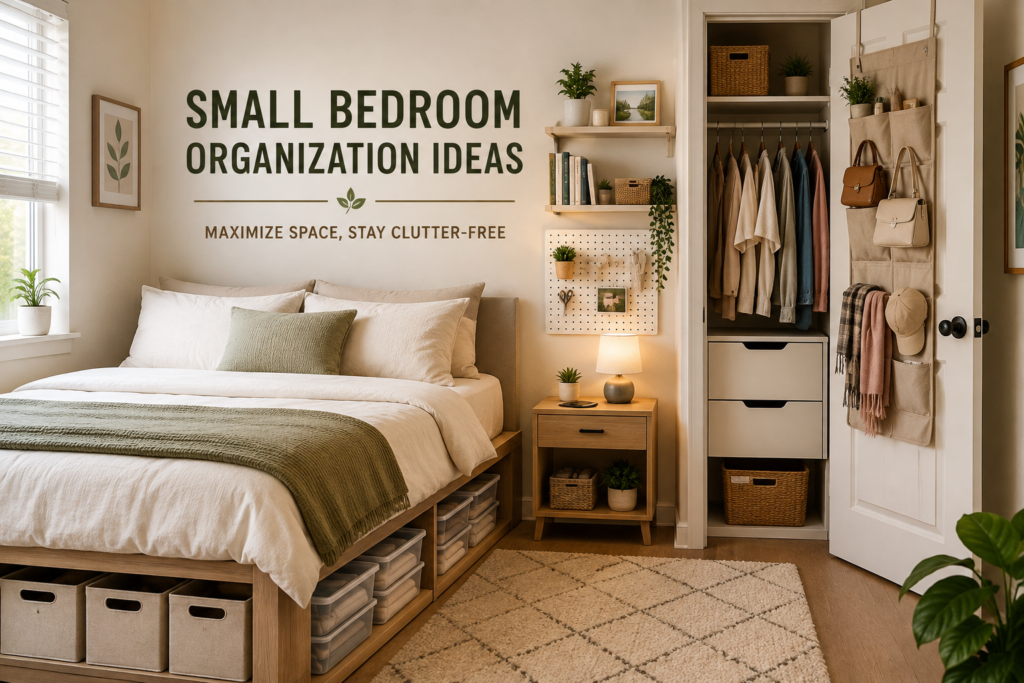
If your bedroom already struggles with multiple clutter zones, our small bedroom organization ideas can help coordinate the rest of the room.
2. Install a Sturdy Wall Hook
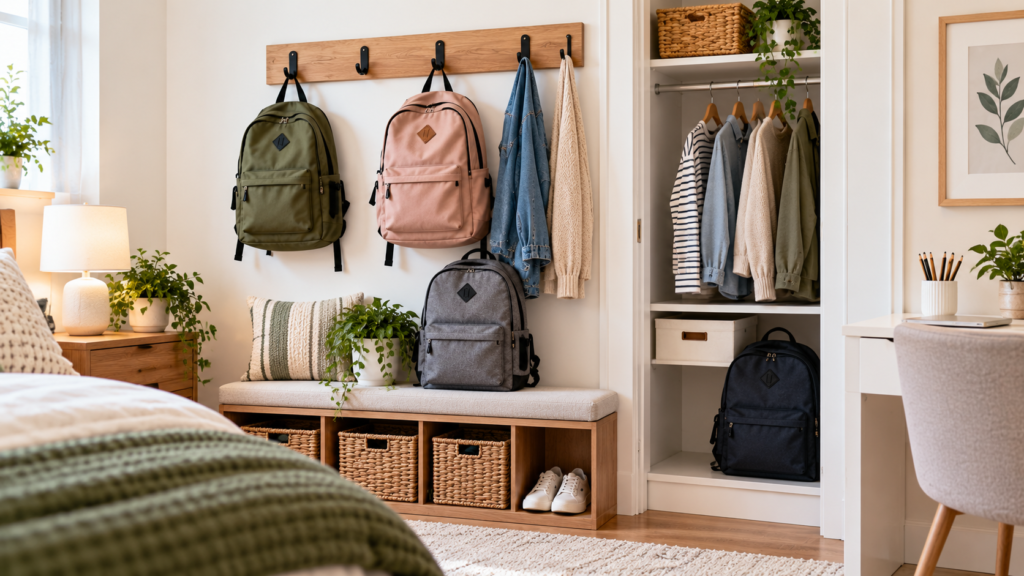
A wall hook can turn unused vertical space into an easy grab-and-go backpack station.
Position the hook where the bag will not block a doorway, light switch, closet door, or walking path. The backpack should hang naturally without dragging across the floor.
Before installation, check the hook’s stated load capacity and use mounting hardware appropriate for the wall and expected weight. A loaded work or school backpack can be considerably heavier than an empty decorative bag.
If the backpack is routinely very heavy, consider storing it on a supported surface instead of leaving its carrying loop under constant strain.
3. Use the Lower Section of a Closet
The lower part of a bedroom closet can work well for backpacks that you want accessible but visually out of the main room.
A clear section of floor, a low shelf, or an appropriately sized cubby can become the backpack zone. Keeping the location near clothing can also make morning routines more efficient.
Avoid burying the backpack behind boxes or seasonal items. Daily storage should not require moving several other things first.
If the closet is already crowded, remove unrelated floor clutter before adding another organizer.
4. Give Backpacks Their Own Shelf
Shelf storage is especially useful for structured backpacks or bags that are frequently loaded.
Instead of suspending the entire weight from a handle, the base of the bag remains supported. A shelf also makes it easy to line up two or three backpacks without stacking them.
Choose a shelf with enough depth for the bag to sit securely without protruding excessively into the room or closet walkway.
For rarely used backpacks, a higher shelf can work. Everyday bags should remain at a comfortable reachable height.
5. Use an Open Basket for Lightweight Backpacks
A large open basket can create a softer, less utilitarian storage solution.
This works best for lightweight backpacks, drawstring bags, reusable totes, or small daypacks rather than large heavily loaded bags.
Choose a basket wide enough that the backpack can be placed inside without being tightly folded. An open top makes it easier to return the bag quickly.
Do not let the basket become a collection point for unrelated bedroom clutter. Once too many categories share the same container, the backpack becomes difficult to retrieve.
6. Add a Backpack Station Beside the Desk
If the backpack carries a laptop, notebook, charger, or work supplies, the desk area may be the most logical storage location.
A hook attached to an appropriate side surface, a low cubby, or a dedicated floor position beside the desk can keep the bag close to the items that regularly move in and out of it.
This arrangement also creates a natural packing station. At the end of the day, paperwork or other essentials can be returned to the backpack without carrying them across the bedroom.
Keep cables and charging equipment organized separately so backpack straps do not become tangled with cords.
7. Use a Bench or Low Storage Unit
A bedroom bench or low storage unit can provide a convenient supported surface for one or two backpacks.
This is useful when you do not want to install wall hardware or when the backpack is too heavy for a simple hook.
If the furniture has open cubbies underneath, reserve one cubby for the bag while keeping the top available for sitting or other intended uses.
Avoid piling clothing on top of the backpack. Once the storage area becomes buried, the system loses much of its convenience.
8. Separate Everyday and Occasional Backpacks
Not every backpack deserves the same prime storage location.
Keep the bag used for work, school, or everyday errands in the easiest-to-reach position. Hiking packs, travel backpacks, and occasional bags can move to a secondary shelf or another suitable storage area.
This prevents infrequently used bags from competing for valuable everyday space.
The same principle works for other accessories. Our bedroom handbag storage ideas explain how separating everyday and occasional bags can simplify bedroom storage.
9. Build a Simple Grab-and-Go Station
For an especially practical setup, combine backpack storage with only the essentials you routinely need when leaving home.
The backpack might sit on a shelf or hook with a small tray nearby for items such as an access card or other everyday carry essentials.
Keep the station intentionally limited. It should support the routine rather than becoming another general-purpose dumping surface.
At night, return the backpack to its position, remove anything that does not need to travel again, and prepare the essentials required for the following day.
Backpack Storage Ideas for a Small Bedroom
In a compact bedroom, backpack storage should use existing space before introducing another large piece of furniture.
Start with vertical space, an available closet section, the side of an appropriate storage unit, or an existing shelf. A single well-positioned storage point is often more effective than a large multi-bag organizer.
Keep floor clearance in mind. A backpack placed in a narrow walkway can quickly become an everyday obstacle.
If several bags are competing for limited space, keep only the everyday backpack immediately accessible and move occasional bags to secondary storage.
Seasonal accessories can be managed separately using ideas from our bedroom seasonal clothing storage guide, leaving prime bedroom storage for items currently in use.
How to Choose the Right Backpack Storage System
Use three factors to decide which approach fits your room.
Frequency of Use
A backpack used every day should require almost no effort to retrieve or return. Occasional bags can be stored farther away.
Bag Weight
Heavier backpacks benefit from supported storage such as shelves, cubbies, or low furniture. If using hooks, follow the hardware manufacturer’s installation and load instructions.
Available Space
Use the space your bedroom already has. A closet shelf makes more sense than adding a freestanding rack when floor space is limited.
Scroll sideways to read the full table.
| Storage Method | Best For | Main Advantage |
|---|---|---|
| Wall hook | Frequently used lightweight bags | Uses vertical space |
| Closet shelf | Everyday or occasional backpacks | Keeps bags visually contained |
| Open basket | Lightweight bags and daypacks | Quick to put away |
| Desk-side station | Work or study backpacks | Supports packing routines |
| Low bench or cubby | Heavier backpacks | Provides supported storage |
Common Backpack Storage Mistakes
Leaving the Backpack in a Walkway
A bag on the floor near the bed or doorway can become a tripping obstacle. Give it a location outside normal walking paths.
Using a Weak Hook for a Heavy Bag
Do not assume every decorative hook can support a loaded backpack. Check installation requirements and load guidance before using wall-mounted storage.
Keeping Every Backpack in Prime Storage
Travel and occasional bags do not need the same convenient location as the backpack used every day.
Turning the Backpack Zone Into General Storage
When shoes, clothes, papers, packages, and unrelated items begin accumulating around the backpack, the system becomes another clutter zone.
Never Emptying the Backpack
Even a perfectly stored backpack can become disorganized inside. Receipts, empty bottles, outdated papers, and unnecessary items gradually add weight and clutter.
A Simple Weekly Backpack Reset
A quick reset once a week can prevent the backpack itself from becoming a portable junk drawer.
- Empty unnecessary papers, receipts, wrappers, and other accumulated items.
- Return items that belong elsewhere in the bedroom or home.
- Check small pockets for forgotten objects.
- Restock only the everyday essentials you actually need.
- Inspect straps, zippers, and handles for obvious damage.
- Return the backpack to its dedicated storage location.
The routine should take only a few minutes when the backpack already has a permanent home.
Backpack Storage and Bedroom Safety
Wall-mounted hooks and shelves should be installed according to their manufacturer’s instructions and matched to the wall construction and expected load.
For freestanding furniture used as part of the storage system, consider tip-over safety—especially in homes with children. The U.S. Consumer Product Safety Commission provides guidance on securing furniture through its Anchor It! furniture safety program.
Keep backpacks away from doorways and clear walking routes, and avoid storing heavy bags where they could easily fall from an elevated surface.
Frequently Asked Questions
1. Where should I keep a backpack in my bedroom?
Choose a location close to your normal routine, such as beside the desk, inside the closet, near the bedroom entrance, or on a suitable shelf. Everyday bags should be easy to reach without blocking walking space.
2. Is it better to hang or shelve a backpack?
Either can work. Lightweight everyday backpacks are convenient on properly installed hooks, while heavier or structured backpacks often benefit from the support of a shelf or cubby.
3. How can I store a backpack in a small bedroom?
Use existing vertical or closet space first. A single wall hook, closet shelf, or compact desk-side position can provide useful storage without adding another large organizer.
4. How do I store multiple backpacks?
Separate them by frequency of use. Keep the everyday bag in the most accessible position and move travel or occasional backpacks to secondary shelves or storage areas.
5. Can backpacks be stored in baskets?
Yes, particularly lightweight or soft backpacks. Choose an open basket large enough to hold the bag without tightly compressing it.
6. How do I stop backpacks from ending up on the floor?
Create a storage location that is just as convenient as dropping the backpack on the floor. A hook, open cubby, shelf, or basket near your natural entry route usually works better than storage that requires several steps.
7. What should I keep beside my everyday backpack?
Only items that genuinely support your leaving-home routine. Keeping the station limited prevents it from becoming another clutter collection point.
Final Thoughts
The best bedroom backpack storage ideas solve a daily behavior rather than simply hiding the bag.
Give your everyday backpack one predictable home, choose storage that can appropriately support its size and weight, and keep the location close to your normal routine. Wall hooks, closet shelves, open baskets, cubbies, and desk-side stations can all work when matched to the right type of bag.
You do not need to organize every backpack the same way. Keep the bag you use most often convenient, move occasional bags to secondary storage, and use a quick weekly reset to prevent unnecessary items from accumulating inside.
When returning the backpack takes only a few seconds, keeping it off the bedroom floor becomes much easier to maintain.