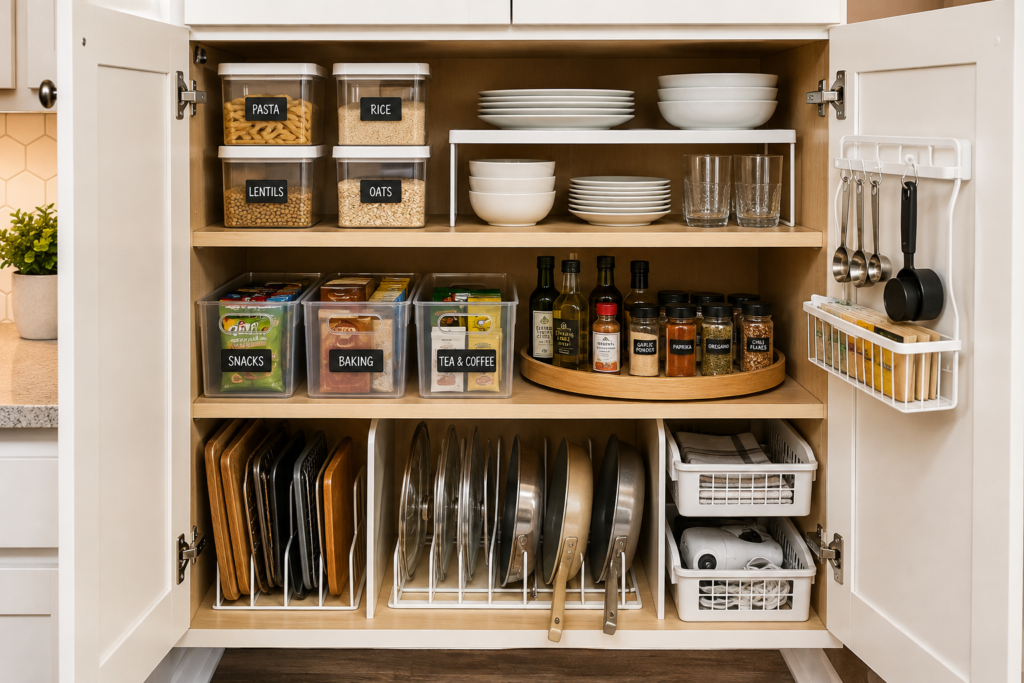
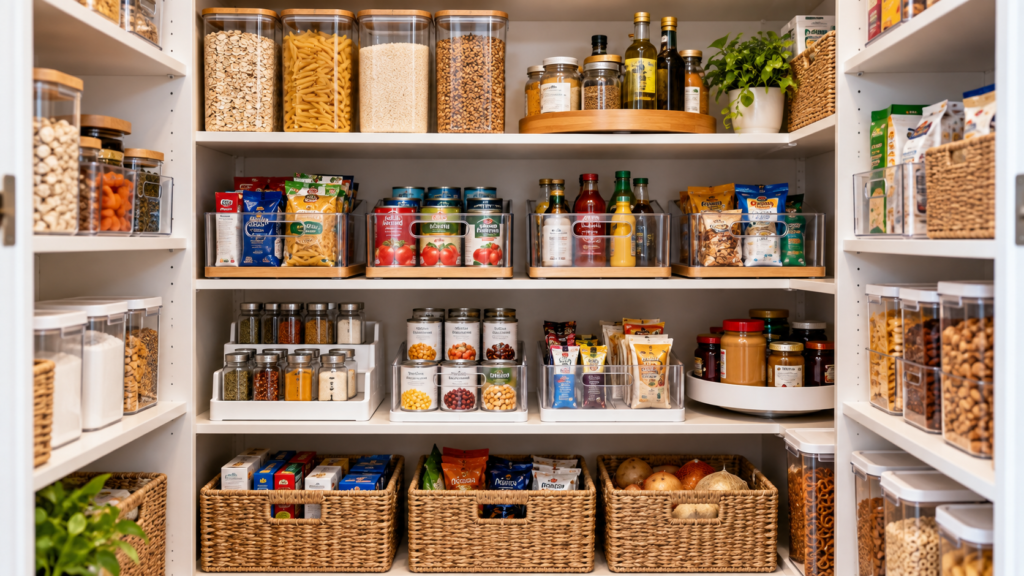
For deep pantry organization ideas, start with one question: can you retrieve the rear item without unloading another category? If not, change the access method before buying more containers. A long removable bin, a rotating tray or a visible stepped row solves a different problem; none is right for every shelf.
This guide focuses on shelf depth, opening clearance and retrieval. For whole-pantry food zones and shopping routines, use our general pantry organization guide. The worked dimensions below are illustrative planning examples, not a tested pantry or product review.
Run a Front-to-Back Access Test on One Deep Shelf
- Choose one frequently used category and count the packages currently on its shelf. Note what is hidden at the rear.
- Retrieve a rear package as you normally would. Count how many unrelated items you must move. Record the number so you can compare layouts.
- Measure shelf depth, clear height and width, plus the narrowest opening beside the door and hinges.
- Try a suitable bin you already own, or group the category in a single visible row. Do not buy a full matching set yet.
- Repeat retrieval and put the item back. Check that the door closes and that the proposed container can be removed without tipping, scraping or becoming too heavy to handle.
Record your result: category ______; unrelated items moved before ______; after ______; rear labels visible ______; door closes ______; loaded container manageable ______. Fewer displaced items is useful only if the new setup also works when putting groceries away.
Choose the Access Method for the Problem
Scroll sideways to read the full table.
| Problem | Option to try; what can make it fail |
|---|---|
| Light packets disappear at the rear | A removable category bin brings the whole group forward. Reject it if the opening blocks removal or its loaded weight is awkward. |
| Small jars hide in a corner | A turntable can rotate labels forward. Check its full loaded rotation; it may use width less efficiently than a row. |
| Rear cans cannot be identified | A stable riser can expose labels. Check loaded height and whether rear cans can be removed without knocking over the front row. |
| Unopened duplicates fill the back | Assign labeled backstock directly behind its matching category. It fails if nobody checks that zone before shopping. |
| Heavy jars make a long bin hard to lift | Use smaller groups or a suitably rated installed pull-out. Check shelving, hardware and installation requirements independently. |
Worked Fit Example: Shelf Width Is Only One Check
Invented example: a shelf has 54 cm of clear width, 46 cm of usable depth and 30 cm of clear height. The opening between door hardware is only 24 cm. A candidate removable bin is 25 cm wide, 42 cm deep and 12 cm high.
- Two bins occupy 2 × 25 = 50 cm, apparently within the 54 cm shelf width.
- However, each 25 cm bin is 1 cm wider than the 24 cm opening. The width calculation alone does not establish that it can be removed upright.
- A 22 cm-wide alternative is narrower than the opening, but still needs any manufacturer-specified clearance and a full removal-path test.
- If a package stands 32 cm high in the loaded bin, it exceeds the 30 cm available height. An empty bin fitting the shelf is insufficient.
Measure the outside dimensions including handles and projecting rims. Test a cardboard footprint and height marker before buying, without forcing anything through the opening. A mock-up checks geometry, not strength, weight rating or the ease of lifting a loaded bin.
For a turntable, compare its outer diameter with both the usable shelf width and depth. Then check rotation with the tallest packages in place. A circular tray fitting an empty shelf does not prove that loaded bottles will clear a hinge or the shelf above.
12 Deep Pantry Organization Ideas to Apply Selectively
1. Put one lightweight category in a removable bin
Packets or bagged snacks are a practical place to start. Label the front with a category the household recognizes. If you must hold a second bin out of the way to remove the first, revise their placement.
2. Try a turntable in a suitable corner
Use this for jars that are difficult to see. Rotate it fully with normal contents and check whether you can grasp each item. Leave it out if a simple row provides better access.
3. Raise a rear row only when it improves retrieval
A riser helps when it reveals labels and leaves enough overhead room to lift out a can. Check stability and load guidance. Extra levels are unhelpful if packages wobble or collide with the shelf above.
4. Keep matching backstock behind the active package
Give each rear zone an identifiable purpose. Mark the front shelf edge with a backstock note so the spare is counted before shopping. Avoid placing unrelated products behind an active category.
5. Decant only where the container solves a problem
Keep original packaging when it is already easy to handle and identify. If transferring food, retain storage directions, ingredients, allergens, preparation details and relevant date or batch information. A matching jar is not worth losing essential label information.
6. Stand small packets in a shallow divider
Use broad groups such as sauces or baking. Check that packets remain visible when the container is partly empty. Avoid a filing system so specific that putting groceries away becomes difficult.
7. Assign categories according to the shelf’s usable geometry
Put tall packages where height allows, and small loose items where they remain visible or can travel forward in a bin. For wider cupboard planning, see kitchen cabinet organization.
8. Avoid pushing every package to the rear
Leave frequently used individual items at a reachable front position. Use depth for a removable group or controlled duplicates. Empty space behind a short row may be preferable to a hidden second category.
9. Match reach height to the person using the shelf
Place everyday items where their user can retrieve and replace them comfortably. Do not put a heavy loaded bin overhead simply to free a lower shelf. Check the shelving manufacturer’s load limits.
10. Give suitable items a small use-first zone
Choose foods to use soon according to their condition, label instructions and meal plans. This is a reminder zone, not a way to make damaged or improperly stored food safe. Review it before adding more packages.
11. Split bulk stock into manageable groups
Several smaller containers may be easier to move than one deep bin filled with cans. Test normal loaded handling without exceeding product limits. Store reusable shopping bags elsewhere if they obscure food; see our bag-storage guide.
12. Leave the operating space your organizer needs
Reserve room for fingers, handles, rotation and drawer travel. Use product instructions and your access test rather than aiming for a universal pantry fill percentage. Capacity is useful when the contents can still be retrieved.
Keep Labels and Follow Food Storage Instructions
The FDA food-storage guidance advises following label storage directions, checking canned goods for damage, and keeping non-perishable foods away from household cleaning products and chemicals. A pantry layout should preserve those requirements.
Do not assume every unopened product belongs at room temperature. Keep required storage information with the food, inspect the shelf when cleaning, and handle damaged or suspect packages according to appropriate food-safety guidance. Organization does not establish that a product is safe to eat.
Review the Shelf After Real Use
On your next shopping cycle, compare the same rear-item retrieval test with your original notes. Can you see duplicates before buying? Does another household member understand where items return? Does the loaded container still move easily?
If the layout fails, change the smallest relevant part: split a heavy category, move a tall package, reduce backstock or remove an unnecessary riser. Keep the arrangements that work instead of rebuilding every shelf for a matching appearance.
Common Deep Pantry Organization Questions
Are long bins always best for deep shelves?
No. A long bin helps only if it passes through the opening, moves along the full removal path and remains manageable when loaded. Heavy products may need smaller groups or another suitable system.
What belongs at the back?
Clearly identified matching backstock or contents in a removable category organizer can work. Avoid burying unrelated everyday foods where they cannot be seen or reached.
Can I improve a deep pantry without buying anything?
Start with visible rows, broad categories, controlled duplicate stock and a note identifying rear packages. Test any suitable containers you already own before purchasing more.
Next step: record one shelf’s opening, depth and loaded height. Choose one access problem to solve and repeat the retrieval test.