Kitchen reusable bag storage ideas can stop cloth totes, produce bags, and insulated carriers from taking over drawers and pantry shelves. A clear system keeps bags clean, visible, and ready before every shopping trip.
Begin by emptying the entire collection. Wash bags according to their care labels, let them dry completely, and remove damaged or unnecessary pieces. Then choose a storage method that matches your available space.
Quick Answer: How Should Reusable Bags Be Stored?
Fold clean, dry bags and store them vertically in one basket near the kitchen exit. Keep only a small working set, separate insulated bags, and place a backup set in the car if useful.
Table of Contents
- 1. File-Fold Bags in a Basket
- 2. Hang Everyday Totes on Hooks
- 3. Use a Magazine Holder
- 4. Add a Door-Mounted Organizer
- 5. Store Bags in One Larger Tote
- 6. Use a Pull-Out Cabinet Bin
- 7. Repurpose a Drawer
- 8. Create a Car-and-Kitchen Split
- 9. Add Shelf Dividers
- 10. Use a Slim Rolling Cart
- 11. Store Insulated Bags Separately
- 12. Set a Practical Bag Limit
- Calculate your bag limit and basket fit
1. File-Fold Bags in a Basket
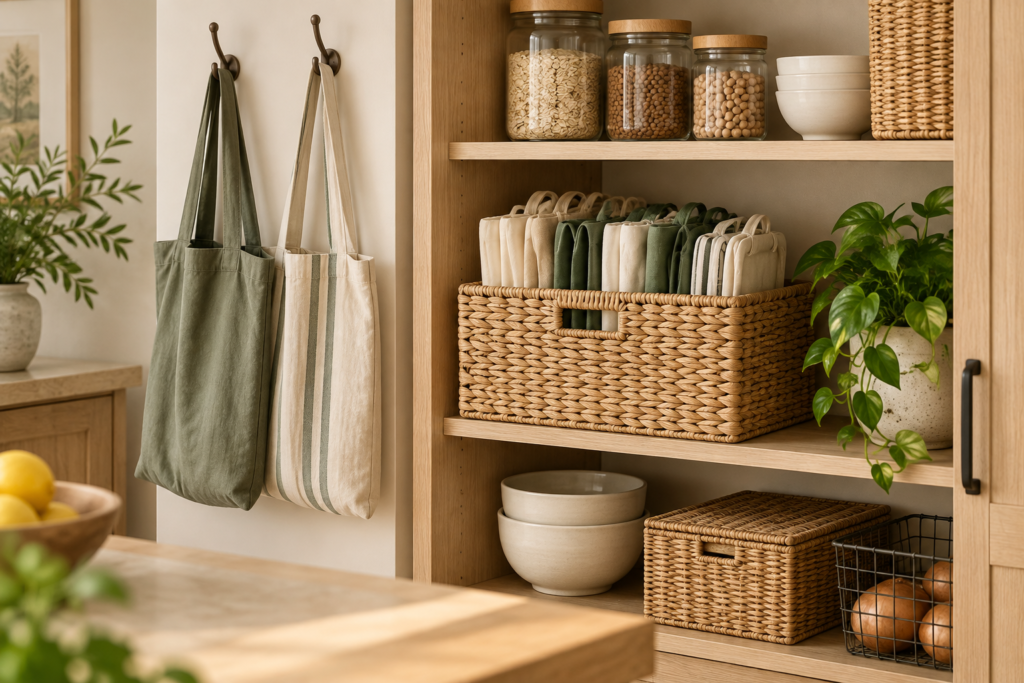
Fold reusable bags into compact rectangles and stand them vertically in a handled basket. File folding lets you see every bag and remove one without disturbing the rest.
2. Hang Everyday Totes on Hooks
Install sturdy hooks inside a pantry, mudroom, or cabinet side panel. Reserve these hooks for two or three frequently used bags and keep the remaining collection folded.
3. Use a Magazine Holder
A wide magazine holder keeps folded bags upright on a shelf. Choose a washable material and avoid overfilling it so bags remain easy to remove.
4. Add a Door-Mounted Organizer
A shallow organizer on the inside of a pantry door uses overlooked space. Check door clearance, hinge strength, and shelf placement before installation.
5. Store Bags in One Larger Tote
Choose one structured reusable tote as the outer container and place neatly folded bags inside it. This portable system can move from pantry to car when needed.
6. Use a Pull-Out Cabinet Bin
A narrow pull-out bin makes deep lower cabinets easier to use. Add dividers for grocery totes, produce bags, and insulated bags.
7. Repurpose a Drawer
A shallow drawer near the kitchen entrance can hold compact folded bags. Use adjustable dividers and keep the drawer below capacity so it closes smoothly.
8. Create a Car-and-Kitchen Split
Keep part of the collection near the kitchen and a small backup set in the car. This prevents every bag from occupying valuable cabinet space.
9. Add Shelf Dividers
Clear shelf dividers stop stacks of folded bags from leaning into food or cookware. Group bags by size and place the most-used group at eye level.
10. Use a Slim Rolling Cart
A narrow cart can hold reusable bags along with recycling supplies. Use labeled baskets and lock the wheels if the cart sits near a busy walkway.
11. Store Insulated Bags Separately
Insulated bags are bulky and need to be completely dry before storage. Nest smaller coolers inside the largest one and place them on a higher shelf.
12. Set a Practical Bag Limit
Keep only the number your household genuinely uses. Donate clean extras where accepted and discard damaged bags according to local guidance.
Cleaning and Food-Safety Tips
- Follow each bag’s washing instructions.
- Let bags dry fully before folding.
- Use separate bags for raw foods and ready-to-eat items.
- Clean storage baskets and shelves regularly.
- Discard bags with damaged linings, persistent odors, or difficult-to-clean spills.
Work Out Your Bag Limit and Basket Capacity
Use the bags you actually need for a normal large shopping trip as the starting point. Count ordinary grocery totes, bags reserved for raw foods, produce bags and insulated carriers separately. If two people shop before the first set is cleaned and dry, include that second trip. A universal household bag number would hide these differences.
Working set = largest normal trip + bags genuinely needed while that set is being cleaned or used elsewhere. Count a car set as part of the total, not an invisible extra collection. Review after several shopping trips and move unused extras out of the everyday zone.
Illustrative quantity and fit example
Suppose a household normally uses four ordinary totes and one insulated carrier. It needs one additional ordinary tote while another is drying. Its starting working set is five ordinary totes plus one insulated carrier, with raw-food and produce separation planned for that trip. This is an example to adapt, not a food-safety recommendation about a fixed quantity.
Scroll sideways to read the full table.
| Measure | Example | What it tells you |
|---|---|---|
| Basket inside dimensions | 24 cm wide × 30 cm front-to-back × 18 cm high | Use inside space, excluding handles and taper. |
| Each folded tote | 20 cm wide × 15 cm high × 3 cm thick | Width and height fit before testing access. |
| Five totes standing front-to-back | 5 × 3 = 15 cm | 15 cm of the 30 cm depth remains. |
| Reserve 6 cm for fingers/removal in this example | 30 − 6 = 24 cm usable stacking depth | The 15 cm stack fits this chosen allowance. |
| Bulky tote folded 7 cm thick | Replace one 3 cm tote: 15 − 3 + 7 = 19 cm | Still below 24 cm, but test the actual loaded basket. |
Bag thickness is uneven, so measure the whole folded set together as well as individual bags. Do not compress bags just to achieve a calculated capacity. If handles catch or a bag cannot be removed without pulling out the whole stack, reduce the working set or change the container. The 6 cm allowance above is an illustrative choice, not a universal clearance.
Fold one tote to match the container
- Start with a clean, completely dry bag on a flat surface. Follow its care instructions.
- Flatten the base and tuck handles inward without forcing rigid parts.
- Fold the sides inward until the width fits the basket opening.
- Fold the bottom toward the top until the height fits. Use an attached storage pocket when supplied.
- Stand the tote upright and measure the whole set. Keep structured or insulated bags separately if folding would damage them.
Keep dirty and ready-to-use bags apart
After unloading, put bags needing cleaning in a separate washable holding place. Return them to the clean basket only when dry. Health Canada recommends cleaning reusable grocery bags, drying them after washing, washing again after food juices leak, and separating raw-food bags from produce bags. See its reusable bags and bins guidance alongside each bag’s care label.
Put the ready set near the exit used for shopping. Before the next trip, check the set rather than taking another loose tote. If a car backup is useful, rotate and clean those bags too. For a larger cabinet reset around this zone, our pantry organization guide covers the wider storage routine.
Choosing Kitchen Reusable Bag Storage Ideas
The most convenient location is usually between the unpacking area and the exit used for shopping trips. In a small kitchen, use the inside of a pantry door or one narrow basket. In a larger kitchen, dedicate a pull-out cabinet bin. Avoid damp utility areas and locations beside heat-producing appliances.
Frequently Asked Questions
Should reusable bags be stored in the car?
A small backup set can stay in the car, but extreme heat and moisture may affect some materials. Keep the main clean collection indoors.
How many reusable bags should a household keep?
Keep enough for a typical large shopping trip plus a few specialty bags. The ideal number depends on household size and shopping habits.
Can reusable bags be stored under the sink?
Only if the cabinet is clean, dry, and separated from chemicals. A pantry or entry cabinet is usually a better choice.
How do you stop folded bags from unfolding?
File them vertically in a snug basket, use simple bands, or fold each bag into its own attached pocket when the design allows.
When comparing kitchen reusable bag storage ideas, focus on convenience, cleanliness, and realistic capacity. The best kitchen reusable bag storage ideas fit naturally between unpacking groceries and leaving for the next shopping trip.
Final Thoughts
The best kitchen reusable bag storage ideas are simple enough to maintain after every trip. Clean and dry each bag, fold it consistently, store the collection in one defined zone, and keep only what your household uses.