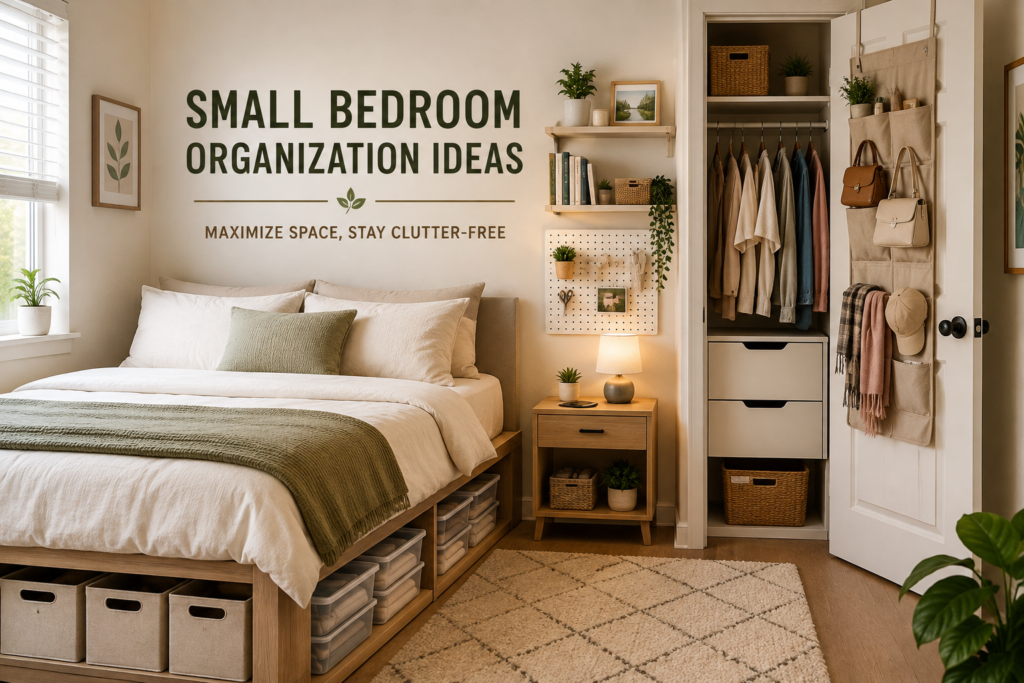

Start with the books you use in this room, then choose storage for their measured size. A bedside shelf suits current reading; a supported shelf row suits the main collection; a dry, accessible container can hold occasional reads. These bedroom book storage ideas help you make that choice without filling every surface.
This is a planning guide, not a product test. The capacity example below uses invented measurements to explain the method. The featured image illustrates an idea; it does not document a completed Nestivoza project.
Choose Storage by What You Read Here
Separate current reading, reference books and books you rarely open. Give each group a location before comparing furniture. If you cannot name what will go in a new organizer, postpone buying it.
Scroll sideways to read the full table.
| Your situation | Start here; check this limit |
|---|---|
| A few books beside the bed | Use an existing nightstand shelf. Keep the lamp, phone and other essentials usable. |
| A larger collection used often | Measure supported shelf rows. Check furniture load limits, stability and anchoring instructions. |
| A bedroom that is also a study | Keep reference books near the desk. Separate them from bedtime reading so returning a book is straightforward. |
| Occasional reads taking prime space | Consider another dry indoor location or a manageable under-bed container. Confirm access and environmental conditions first. |
| A few covers you want to display | Use a purpose-suitable ledge as a rotating display. It is not a substitute for the main collection’s shelving. |
Measure Your Collection Before Buying a Bookcase
A book count alone is misleading: thin paperbacks and large hardbacks use different space. Stand a group of similar-size books upright on a suitable flat surface, supported so they do not lean. Measure the row from end to end without squeezing it. Repeat for each group.
- Record row length. Add the lengths of the groups intended for upright shelving.
- Record the tallest and deepest book. Compare these with clear shelf height and depth, not the bookcase’s outside dimensions.
- Measure usable shelf width. Subtract space occupied by supports, dividers and bookends.
- Allow retrieval space. Choose a gap that lets you remove and return books comfortably. Test it with your books rather than assuming a fixed percentage.
- Check weight separately. Length calculations cannot establish whether a shelf or its fixings can support the collection.
Worked example: four shelves can still be too small
Illustrative calculation, not measurements from a real project: suppose the main collection occupies 180 cm in supported rows. A candidate has four shelves, each 50 cm wide internally. Bookends and supports occupy 4 cm per shelf, and you choose a 3 cm retrieval gap.
Planned book space per shelf = 50 − 4 − 3 = 43 cm. Four shelves provide 4 × 43 = 172 cm. The collection is 8 cm too long, even though the nominal total shelf width is 200 cm.
You could move at least that much of the collection elsewhere, use an additional suitable shelf, or compare a different bookcase. This assumes books can be distributed across the shelves; verify each row. Height, depth, load capacity and furniture installation remain separate checks. Use inches throughout if preferred; do not mix units.
12 Bedroom Book Storage Ideas and When to Use Them
1. Fit a slim bookcase to a measured wall
Use this for the main collection when you have suitable wall space. Mark its outside footprint on the floor and open nearby doors and drawers. Then check internal shelf dimensions using the method above. A narrow outer width does not tell you how many books will fit.
2. Keep current reading in the nightstand
Assign one existing shelf or drawer to the books you are actually reading. Test access from your normal reading position. Return finished books to the main collection instead of allowing the pile to expand across the top.
3. Add a wall shelf in a suitable location
Consider this where floor space is limited and the wall can support an appropriate installation. Books, shelf, brackets, fixings and wall construction must be considered together. Avoid placing heavy book storage above a sleeping area. Follow installation instructions rather than estimating capacity from appearance.
4. Put a small collection beside a reading chair
Use an existing nearby shelf before adding furniture. Check the chair’s occupied space as well as its empty footprint: sit down, stand up and reach for a book without blocking the route through the room. For the wider layout, see our reading-nook planning guide.
5. Use a bookcase as a divider only if its design allows it
This can separate a desk area in a larger bedroom. Check whether the unit is designed for that placement and how it must be secured. A bookcase requiring wall anchoring is not automatically suitable as a freestanding divider.
6. Reassign an existing furniture shelf
Clear a defined section of a suitable cabinet or built-in unit. Measure the space and verify the furniture’s intended use and load guidance. This option avoids another footprint, but it fails if displaced belongings simply become a new pile elsewhere.
7. Use under-bed containers for occasional reads
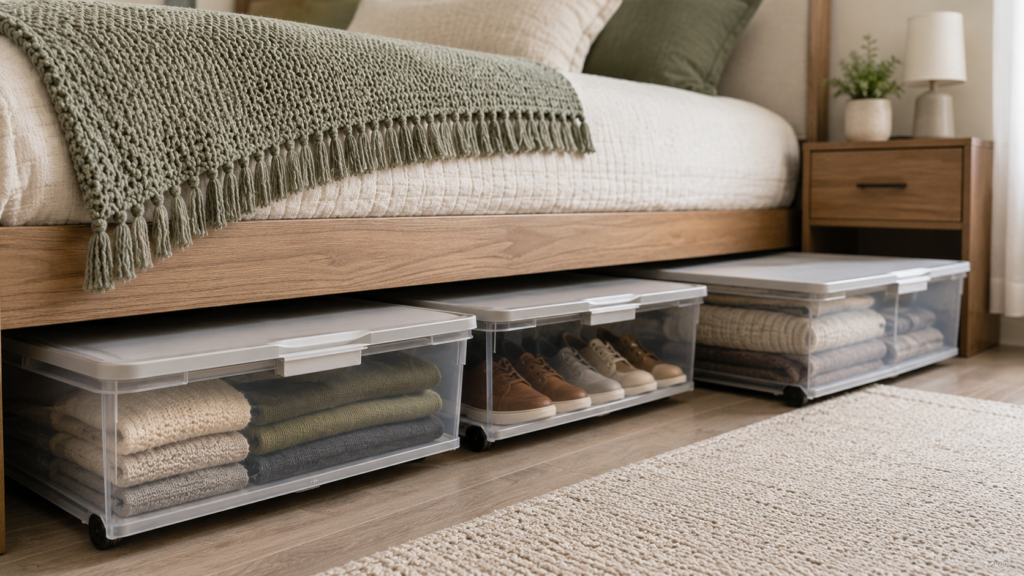
Check the area’s dryness and accessibility first. Measure the opening and the container including lid, wheels and handles. Test removal with nearby furniture in place. Divide books into loads you can handle comfortably; do not choose one large box just because it fits. See under-bed storage planning for other clearance checks.
8. Give active study materials a small cart
A cart suits books that move between desk and chair. It consumes floor space even when mobile, so mark a parking position. Check the manufacturer’s loaded-use instructions and test access on your flooring without exceeding its limits.
9. Rotate a few covers on a display ledge
A ledge works for a small display if its depth, retaining edge and load rating suit the books. Check that books remain supported. Keep the rest of the collection elsewhere so the display does not become tightly packed storage.
10. Group reference books beside the desk
Arrange by the way you retrieve them: a course, project or subject may be more useful than spine color. Keep the desktop available for work. If you must move a stack every time you open a notebook, the storage position needs changing.
11. Use a supportive basket for a limited rotation
Choose a flat, suitable base and enough internal room to avoid bending covers. Test retrieval and the loaded weight. A decorative basket that distorts the books or becomes difficult to lift has not solved the problem.
12. Keep only part of the collection in the bedroom
If the measured collection exceeds usable storage, choose what belongs in another suitable indoor space. Preserve access to clothing and walking routes. Moving occasional reads can work better than adding furniture that obstructs the room. Apply the same frequency-of-use principle to seasonal clothing storage.
Protect the Books and Check the Furniture
The Library of Congress storage guidance recommends supporting upright books so they do not lean, minimizing intense light exposure, and using suitable stable environmental conditions. Oversized books may need to lie flat with full support. Fragile or valuable books can need more specialized housing than everyday storage.
For furniture safety, consult the CPSC Anchor It! campaign and follow the furniture manufacturer’s anchoring instructions. Neither a book count nor our row-length calculation establishes a safe load. Get appropriate installation help when wall construction or fixings are uncertain.
Try a No-Buy Layout Before Committing
- Choose one shelf for the main collection and one small place for current reading.
- Put books away without forcing them into gaps or making them lean.
- Retrieve a book from each group and return it. Check that nearby drawers and doors still work.
- After your next reading session, notice where the book actually lands. If it repeatedly misses its assigned home, adjust that location.
- Buy additional storage only for the measured shortfall, after checking dimensions and load requirements.
Common Bedroom Book Storage Questions
Can I store books without buying a bookcase?
Yes, if existing suitable furniture has enough supported space and load capacity. Start with a defined shelf or nightstand section. Containers for occasional reads should protect the books and remain accessible.
How many books fit on a shelf?
Measure the actual supported row rather than using a universal books-per-shelf estimate. Check usable width after supports and bookends, plus each book’s height and depth. Confirm load capacity independently.
Are under-bed books safe from damage?
A lid alone cannot establish this. Consider moisture, light, support, pests, cleaning access and the condition of the books. Choose a better location if the area is damp or cannot be inspected easily.
Next step: measure one group of books and one candidate shelf. Resolve that fit before reorganizing the whole bedroom.