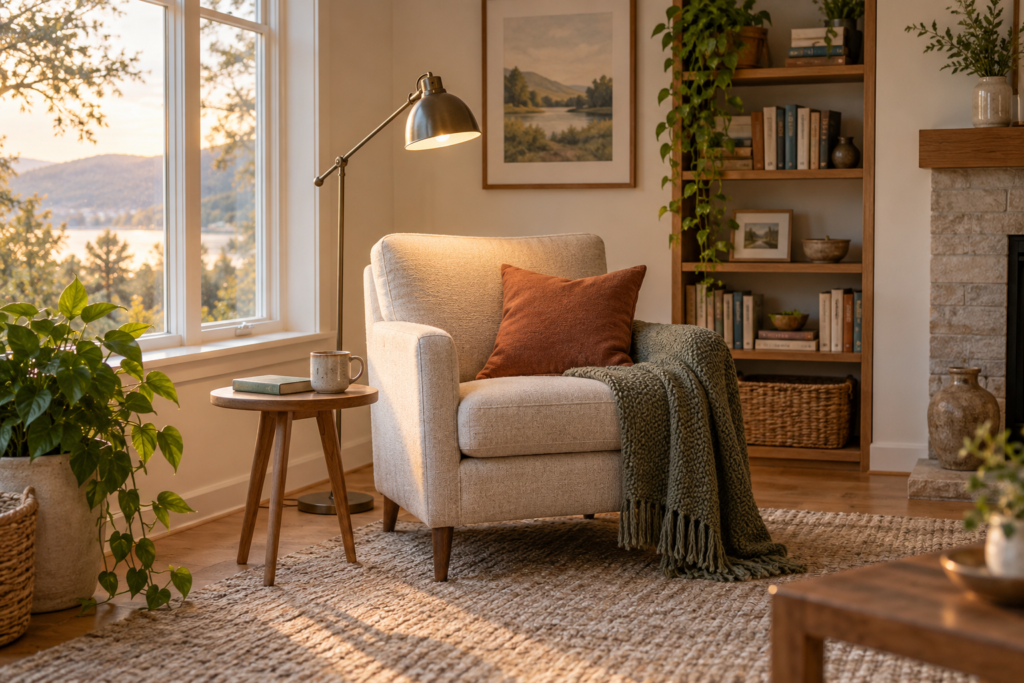
A comfortable reading corner does not require a separate library or a large floor plan. The best living room reading nook ideas combine supportive seating, well-positioned light, useful storage, and enough separation from everyday distractions. With careful planning, an unused corner, window area, or space beside a bookshelf can become a practical place to read and relax.
Before buying furniture, observe how daylight moves through your living room and measure the available area. Think about who will use the nook, how long they normally read, and where books, glasses, drinks, and charging cables will go. The following ideas work across compact apartments and larger family rooms without making the space feel crowded.
Table of Contents
- Choose the Right Location
- Start With a Supportive Chair
- Layer the Lighting
- Use the Space Beside a Window
- Add a Small Side Table
- Keep Book Storage Within Reach
- Define the Nook With a Rug
- Add Comfortable Textiles Carefully
- Use Wall Space in a Small Room
- Create Separation in a Shared Living Room
- Plan a Flexible Family Reading Nook
- Finish With Personal Details
- What to Measure Before You Begin
- Reading Nook Mistakes to Avoid
- Frequently Asked Questions
1. Choose the Right Location
Begin by identifying a part of the room that feels naturally calm. A corner away from the television, a space beside a window, or the end of a sofa can work well. Avoid placing the chair in a busy walkway or where opening doors will interrupt the reader. Test the location at different times of day because glare, household noise, and traffic patterns can change.
Leave enough clearance to sit down comfortably and reach a lamp or table without twisting. If you are reorganizing the whole room, review these living room furniture arrangement ideas to preserve balanced circulation around the new zone.
2. Start With a Supportive Chair
The chair is the most important part of a reading nook. Choose one that supports your back and allows your feet to rest comfortably on the floor or a stable footstool. A deep lounge chair may feel inviting, but it should not force your neck forward or make it difficult to stand. Sit in the chair before purchasing whenever possible.
For small living rooms, select an armless chair or a compact accent chair with a narrow frame. In a larger room, a high-back chair can provide more visual separation and head support. Durable, easy-to-clean upholstery is useful in homes with children or pets.
3. Improve Living Room Reading Nook Ideas With Layered Lighting
A reading nook needs focused task lighting even when the room already has a ceiling fixture. Position a floor or table lamp slightly behind and beside the reader so light reaches the page without shining directly into the eyes. Adjustable shades and swing-arm lamps make it easier to direct light for different seating positions.
Use daylight when available, but add a blind or curtain if the window creates glare. Choose efficient bulbs with enough brightness for comfortable reading and check the fixture’s maximum wattage before installation. The U.S. Department of Energy provides helpful guidance about energy-efficient lighting choices.
4. Use the Space Beside a Window
A window can make a reading nook feel open and connected to the outdoors. Place the chair beside the window rather than directly in front of it so the furniture does not block light or access. If direct sun fades upholstery or heats the area, use a light-filtering shade and rotate vulnerable books away from strong sunlight.
Keep enough distance between curtains and lamps, heaters, or radiators. A narrow bench can work beneath a suitable window, but only if it is stable, properly supported, and does not obstruct a required exit or ventilation source.
5. Add a Small Side Table
A side table gives books, reading glasses, and a drink a dependable landing place. Its top should be close to the height of the chair arm so items are easy to reach. A table that is too low encourages awkward bending, while an oversized table can restrict movement and make the nook look crowded.
Choose a stable design with rounded edges for tight walkways. A table with one drawer or a lower shelf can hold bookmarks and chargers, but avoid turning it into general household storage. Keeping the surface mostly clear makes the reading nook easier to reset after use.
6. Keep Book Storage Within Reach
Store only current reads and a few favorites beside the chair. A compact bookcase, wall shelf, magazine rack, or sturdy basket can keep books close without overwhelming the corner. Place heavier books on lower shelves and confirm that tall furniture is secured appropriately, especially in homes with children.
Avoid filling every shelf completely. Open space makes titles easier to see and leaves room for the collection to change. For a larger collection, use the systems in our living room bookshelf organization guide and rotate a smaller selection into the nook.
7. Define the Nook With a Rug
A small rug can visually separate the reading area from the rest of an open living room. Select a size that connects the chair and table instead of leaving them floating as unrelated pieces. At minimum, the front legs of the chair should rest securely on the rug.
Use a non-slip pad and make sure the edges remain flat. High-pile rugs can feel soft but may interfere with walkers, wheelchairs, small tables, or frequently used pathways. A low-pile washable rug is often easier to maintain while still adding warmth, color, and definition.
8. Add Comfortable Textiles Carefully
A breathable throw and one supportive cushion can make the chair more comfortable without burying it under accessories. Use the cushion to improve posture or fill an uncomfortable gap rather than adding it only for appearance. Washable covers are practical when the nook is used daily.
Coordinate two or three colors with the main living room so the nook feels intentional. Store the throw in a nearby basket when it is not needed. Too many cushions and blankets reduce usable seat depth and can turn an otherwise practical reading space into another cluttered surface.
9. Use Wall Space in a Small Room
Small-space living room reading nook ideas work best when the floor remains open. Replace a wide bookcase with one or two properly installed floating shelves, and use a wall-mounted reading light if there is no room for a floor lamp. Keep shelves shallow enough that people do not bump into them when standing.
Follow the manufacturer’s fixing instructions and use hardware suitable for the wall type and expected load. Do not position heavy objects directly above the reader. A narrow picture ledge can display a small rotating selection of books without adding bulky furniture.
10. Create Separation in a Shared Living Room
In a multifunctional room, angle the reading chair away from the television and toward a window, lamp, or bookshelf. This small change signals that the corner has a different purpose. A tall plant, open bookcase, or the back of a sofa can provide gentle separation without constructing a wall.
Do not use a divider that blocks daylight, heating controls, or the main walking route. Headphones can help in a noisy household, while a small tray keeps personal reading items together so the nook can be cleared quickly when the room is needed for guests.
11. Plan a Flexible Family Reading Nook
A family nook should adapt to different ages and routines. Pair the main chair with a washable floor cushion, small stool, or nearby sofa seat instead of crowding several permanent chairs into one corner. Keep children’s books on a low, accessible shelf and adult books higher up.
Round sharp corners where practical, contain lamp cords, and keep small decorative objects out of reach of young children. Use a basket for library books so they remain separate from owned books and are easier to return on time. A flexible setup can support quiet reading without taking over the living room.
12. Finish With Personal Details
Personal details make the nook inviting, but each addition should earn its place. Consider one framed print, a healthy plant suited to the available light, or a small object connected to your favorite books. Keep the palette consistent with the surrounding room so the corner looks integrated rather than staged.
Leave breathing room around books, lighting, and seating. The goal is to create a place you genuinely use, not a decorative display that requires constant rearranging. Review the setup after a week and remove anything that limits comfort or collects dust without adding value.
What to Measure Before Creating a Reading Nook
Accurate measurements prevent overcrowding and unnecessary purchases. Record the full width and depth of the available area, then compare those figures with the chair in both its normal and reclined positions. Include the side table, lamp base, rug, and clearance required to sit down safely.
- Measure the chair’s total width, depth, height, and seat height.
- Allow comfortable access from the main living-room walkway.
- Check the distance between the lamp and reading position.
- Locate outlets before planning lamp and charger placement.
- Confirm that shelves will not obstruct doors, curtains, or windows.
- Use painter’s tape to test the complete footprint before buying.
Living Room Reading Nook Ideas: Mistakes to Avoid
A beautiful chair cannot compensate for poor lighting, restricted access, or an uncomfortable layout. One common mistake is buying furniture from photographs without checking its dimensions against the available space. Another is placing the nook where television glare, conversations, or household traffic make concentration difficult.
- Relying only on a distant ceiling light.
- Choosing style over back, neck, and arm support.
- Blocking a doorway, vent, radiator, or window treatment.
- Allowing loose lamp and charging cords across the floor.
- Installing overloaded or poorly anchored wall shelves.
- Adding so many accessories that the chair becomes difficult to use.
- Storing more books than the nook can hold safely.
Frequently Asked Questions
How much space is needed for a living room reading nook?
There is no fixed minimum, but the area must accommodate the chair’s full footprint, a safe way to enter and leave it, and any table or lamp you plan to use. Compact arrangements can fit into an unused corner when furniture dimensions are checked carefully. Test the footprint with painter’s tape before purchasing anything.
Where should a reading lamp be placed?
Place the lamp slightly behind and beside the reader so light falls across the page without creating direct glare. The best side may depend on whether the reader is left- or right-handed. An adjustable lamp provides more flexibility, but its cord should remain secured and outside the walking path.
Can I create a reading nook without buying new furniture?
Yes. Reposition a comfortable chair you already own, move an existing lamp closer, and use a small table, stool, basket, or shelf already available in your home. Often the most effective improvement is changing the layout and removing distractions rather than purchasing additional décor.
Final Thoughts
The most successful living room reading nook ideas focus on real comfort and everyday use. A supportive chair, controlled lighting, reachable storage, and safe circulation matter more than filling the corner with decorative accessories. Start with the location and seating, then add only what improves the reading experience.
Measure carefully, test the arrangement, and adjust it after using the nook for several days. Even a modest corner can become a calm and useful part of the living room when every element has a clear purpose.