
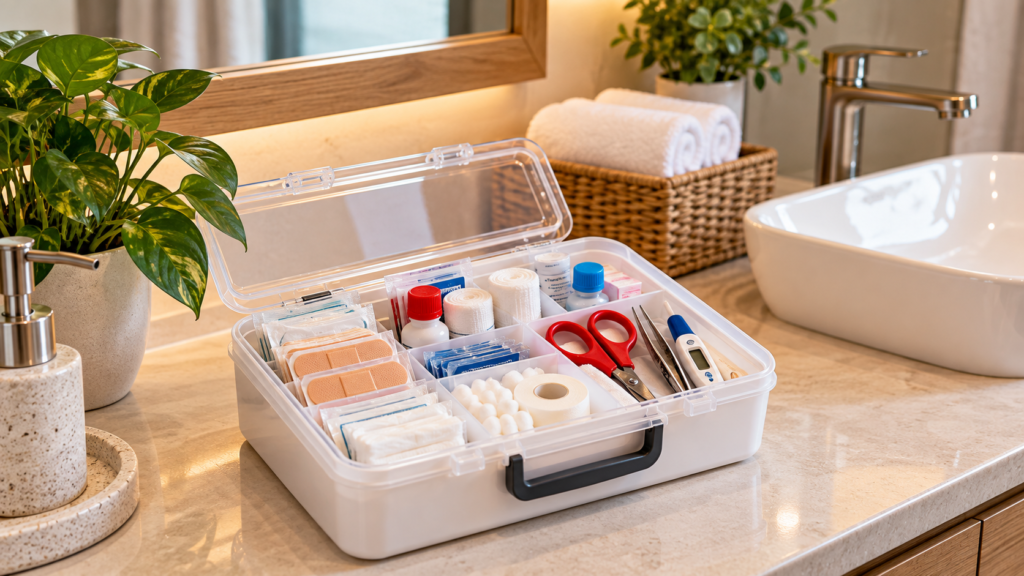
A first aid collection is most useful when you can find what you need quickly. But loose bandages, gauze packets, tape, thermometers, and other small supplies can easily disappear into crowded drawers or get mixed with everyday bathroom products.
These bathroom first aid storage ideas focus on creating a simple, visible, and easy-to-maintain system for non-prescription first aid supplies. Just as importantly, they help you decide which items actually belong in a bathroom and which should be stored somewhere cooler and drier.
The goal is not to create a complicated medical cabinet. It is to give everyday first aid essentials a defined home so they are easier to locate, inspect, and restock.
Table of Contents
- Before You Organize First Aid Supplies
- 12 Bathroom First Aid Storage Ideas
- How to Choose the Right Storage Location
- Simple First Aid Storage Maintenance
- Common Storage Mistakes to Avoid
- Frequently Asked Questions
- Final Thoughts
Before You Organize First Aid Supplies
Start by gathering your household first aid items in one place. You may find adhesive bandages in one drawer, gauze somewhere else, and tweezers or medical tape mixed with grooming products.
Sort everything into broad groups such as wound care, protective items, small tools, and frequently used supplies. Remove damaged packaging and check expiration dates where applicable.
The American Red Cross recommends keeping a well-stocked first aid kit available, checking it regularly, and replacing used or out-of-date contents. That makes periodic review just as important as choosing attractive organizers.
Important: do not assume that every medicine should be stored in a bathroom cabinet. Heat and humidity can affect some medications. Follow the storage instructions on each product label, and use a cool, dry location when required.
12 Smart Bathroom First Aid Storage Ideas
1. Create One Dedicated First Aid Zone
The simplest improvement is often giving first aid supplies one clearly defined location instead of scattering them throughout the bathroom.
This might be a particular drawer, shelf, cabinet section, or portable container. A dedicated zone reduces searching because household members know exactly where basic supplies should be returned after use.
Keep unrelated toiletries out of this area whenever possible. Mixing bandages with cosmetics, hair accessories, and skincare products makes the storage space harder to scan.
2. Use a Portable First Aid Box
A portable box is especially useful when bathroom storage is limited or when the room experiences noticeable humidity.
Choose a container that is large enough for your core supplies without requiring everything to be tightly packed. Internal compartments can separate adhesive bandages, gauze, tape, gloves, and small tools.
Portability also means the entire kit can be moved to another room when needed rather than carrying individual items back and forth.
3. Divide a Drawer Into First Aid Categories
If you have a spare vanity drawer, shallow dividers can turn it into an easy-to-scan first aid station.
Instead of creating one large pile, assign small sections to categories such as:
- adhesive bandages,
- gauze and dressings,
- medical tape,
- disposable gloves, and
- small first aid tools.
Keep frequently needed items toward the front and less frequently used supplies toward the back. This simple arrangement prevents everyday use from disrupting the entire drawer.
If your vanity drawers already hold personal-care products, our bathroom drawer organization ideas can help you divide the available space more deliberately.
4. Use Small Open Bins Inside a Cabinet
Deep bathroom cabinets can hide small first aid packets behind larger products. Small bins create boundaries and let you pull an entire category forward at once.
For example, one bin can hold wound-care supplies while another holds gloves and basic tools.
Avoid using containers that are much deeper than the items inside them. When supplies become stacked several layers high, visibility drops and forgotten products accumulate at the bottom.
5. Label Containers by Purpose
Labels are particularly helpful when several people use the same first aid supplies.
Simple labels such as Bandages, Gauze, Tools, and Gloves are usually more useful than highly detailed categories.
The purpose is to make the system understandable at a glance. If a labeling system requires too much thought every time an item is returned, it is unlikely to stay organized for long.
6. Keep Frequently Used Basics at the Front
Not every first aid item needs the most convenient position.
Items used more often—such as adhesive bandages—can stay toward the front of a drawer or bin, while backup supplies remain behind them.
This prevents you from moving several packages every time you need one small item and makes it easier to notice when everyday essentials are running low.
7. Separate Backup Supplies From the Active Kit
If you buy bandages, gauze, or other supplies in larger packages, avoid crowding every spare item into your primary first aid area.
Keep a practical quantity in the active kit and store unopened backups in a separate labeled container where storage conditions are appropriate.
When the active supply runs low, refill it from the backup stock. This approach keeps the everyday kit compact while still making restocking easy.
8. Store Small Tools in Their Own Compartment
Tweezers and first aid scissors can disappear beneath packets and dressings when everything shares one container.
A narrow compartment or small tray keeps these tools visible and prevents them from shifting throughout the drawer.
Keeping tools separate also makes inventory checks easier because you can immediately see whether an essential item is missing.
9. Keep Sterile Supplies Protected
Gauze pads, dressings, and similar products should remain in intact packaging until needed.
Do not unpack supplies simply to make a container look more uniform. If packaging becomes wet, torn, opened, stained, or otherwise damaged, evaluate whether the item should be replaced.
This is one reason first aid organization should prioritize protection and usability rather than appearance alone.
10. Add an Easy-to-Reach Restock Area
A small “restock” section can prevent partially empty packages from being forgotten.
When you notice that an item is running low, place its empty package, label, or a written reminder in this section. Then review the list before your next household shopping trip.
This works particularly well for families because one person does not have to remember every item another person used.
11. Use Vertical Cabinet Space Carefully
If a cabinet has unused height, a small shelf riser can create a second level for lightweight supplies.
Place shorter containers on the lower level and items that need less frequent access above them. Avoid unstable stacks that could fall when the cabinet is opened.
If the cabinet also stores toiletries, keep the first aid section visually separate rather than filling every available inch.
For broader cabinet organization, see our medicine cabinet organization ideas.
12. Create a Quick-Check Inventory Card
A small inventory card inside the first aid box or cabinet can make maintenance much easier.
List your core supplies and add a simple date for the last review. You do not need a complicated spreadsheet for a household kit—a short checklist is often enough.
During each review, look for missing items, expired date-sensitive products, damaged packaging, or supplies that need replenishment.
The American Red Cross recommends checking first aid kits regularly and replacing expired or damaged contents, so a visible review reminder can turn that guidance into an easy household routine.
How to Choose the Right First Aid Storage Location
A convenient location is useful only if the environment is suitable for the items being stored.
Before choosing a bathroom cabinet or drawer, consider these factors:
Accessibility
Adults who may need the kit should know where it is and be able to reach it quickly. Avoid hiding the entire kit behind rarely moved household products.
Humidity
Bathrooms can become humid after showers and baths. Products with specific temperature or moisture requirements should be stored according to their labels rather than automatically placed in the bathroom.
Child Safety
If children are present, accessibility for adults must be balanced with safe storage. Medicines in particular should be kept where children cannot see or reach them and according to their required storage conditions.
Space
The storage area should have enough room for supplies to remain visible. A tightly packed container encourages stacking and makes routine checks harder.
If your bathroom is especially compact, you may also find useful space-saving strategies in our small bathroom storage ideas.
A Simple First Aid Storage Maintenance Routine
An organized first aid area still needs occasional attention. A short routine can prevent clutter and outdated supplies from building up again.
- Remove everything: Empty the kit or storage section so hidden items are visible.
- Inspect packaging: Look for opened, torn, wet, stained, or otherwise damaged packaging.
- Check dates: Review expiration dates on date-sensitive contents and replace items as appropriate.
- Count essentials: Restock frequently used basics before they run out.
- Clean the container: Wipe out dust or debris before replacing supplies.
- Return items by category: Keep the same simple zones instead of creating new categories every time.
- Record the review: Add the date to your inventory card.
A regular review is more valuable than trying to build a perfectly arranged cabinet once and then forgetting about it.
What Should a Basic First Aid Storage Area Hold?
Your household needs may vary, so there is no reason to copy another person’s kit exactly. However, common first aid supplies may include adhesive bandages in different sizes, gauze pads, roller bandages, adhesive tape, disposable non-latex gloves, tweezers, scissors, and an instant cold pack.
The American Red Cross publishes a more detailed first aid kit checklist that can be used as a reference when reviewing your household supplies.
Remember that having an item and storing it correctly are separate issues. Always follow individual product labels, particularly for medicines or products with specific storage requirements.
Common First Aid Storage Mistakes to Avoid
Mixing First Aid Supplies With Everyday Clutter
If bandages and gauze are buried beneath cosmetics, spare toiletries, or grooming tools, they become harder to find when needed. Give first aid supplies a clearly defined boundary.
Assuming the Bathroom Is Suitable for Every Item
This is one of the most important mistakes to avoid. Bathrooms may experience heat and moisture. The FDA advises storing medicines according to their labels and generally in a cool, dry place. A bathroom cabinet may therefore be inappropriate for many medications.
Removing Important Packaging
Do not discard useful labels or instructions simply to make storage containers look cleaner. Original information can contain directions, expiration dates, warnings, and storage requirements.
Ignoring Expiration Dates
Some first aid kit contents are date sensitive. Checking them periodically prevents expired products from occupying valuable storage space.
Overfilling the Kit
A container packed to the point where you must remove half its contents to find something is not efficiently organized. Keep the active kit practical and store suitable backup supplies separately.
Creating Too Many Categories
A complicated system can become difficult to maintain. Four or five broad categories are often easier to use than a separate container for every small product.
Frequently Asked Questions
1. Is the bathroom a good place to store a first aid kit?
It can work for certain non-medication supplies if the area stays reasonably dry and the products’ storage instructions allow it. However, bathrooms often experience humidity, so medicines and moisture-sensitive products may need a cooler, drier location.
2. Should medicines be stored in a bathroom first aid cabinet?
Not automatically. Follow the storage instructions on the medicine label. FDA guidance generally recommends a cool, dry location for medicines unless specific instructions say otherwise.
3. How should I organize small first aid supplies?
Use a few simple categories such as bandages, dressings, protective supplies, and tools. Small bins or drawer dividers help keep packets upright and visible.
4. How often should I check my first aid supplies?
Check them regularly and after significant use. Review expiration dates, packaging condition, and stock levels so missing or outdated supplies can be replaced.
5. Should I keep first aid supplies in their original packaging?
Keep important labels, instructions, expiration information, and sterile packaging intact. Avoid removing packaging simply for appearance.
6. How can I keep children away from first aid items?
Choose storage that is inaccessible to young children, particularly for medicines or potentially hazardous products. Follow product-specific safety instructions and use appropriate secure storage when needed.
7. What is the easiest first aid storage system for a small bathroom?
A compact portable kit or one dedicated drawer is usually easier to maintain than several small storage locations. Keep only appropriate supplies there and move products requiring different environmental conditions elsewhere.
Final Thoughts
The best bathroom first aid storage ideas are not about filling a cabinet with matching containers. They are about making essential supplies easy to identify, properly protected, and simple to maintain.
Start with one dedicated zone, use a few practical categories, keep frequently needed supplies visible, and check the contents regularly. Most importantly, pay attention to the storage requirements of individual products rather than assuming everything belongs in the bathroom.
A thoughtful system takes only a small amount of space, but it can make your household first aid supplies much easier to find when you actually need them.