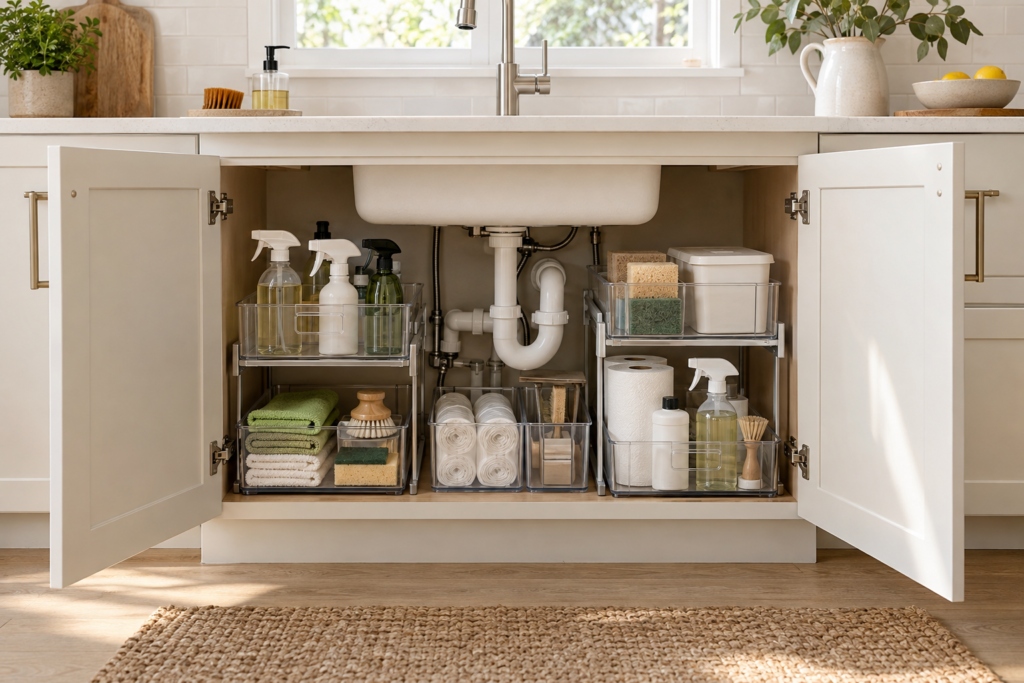
An organizer can fit the advertised width of a kitchen cabinet and still fail beside a drain trap, behind a hinge or beneath the sink basin. Use these under sink kitchen organization checks to record the space an organizer can actually occupy and the route it must travel through.
This guide is a fit worksheet. For choosing what to store, cleaning-product zones and the broader organizing routine, see our kitchen under-sink organization guide. Here, the result is a short list of measurements and a practical pass-or-fail test before a purchase.
12 Checks to Make With the Cabinet Empty
1. Check condition before measuring
Look for active drips, swelling, dampness and damaged supports. Resolve a leak before adding storage. Do not let a new liner conceal the condition of the cabinet base.
2. Measure the internal width
Record the inside distance between cabinet walls. Exterior door width is not the same measurement. Repeat at the front and rear if the walls or frame are uneven.
3. Measure the door opening
Record the narrowest clear opening the organizer must pass through. A fixed face frame or central stile can divide an otherwise wide cabinet. Measure each opening separately.
4. Mark hinge projection
With the door open, note where each hinge projects into the opening and cabinet interior. Check the whole organizer, including rails and handles, against this obstruction.
5. Map the drain trap
Measure where the trap and drain pipe sit relative to the side walls and floor. Sketch their occupied area. Do not assume a bin can use the space beneath a pipe unless it can be removed without touching the pipe.
6. Map other equipment separately
A disposal, filter or water-treatment unit has a different footprint from the drain. Record it as a separate obstruction and follow its service-clearance instructions. Do not invent a general clearance number.
7. Record usable depth
Measure from the interior front boundary to the first obstruction at the intended height. The cabinet may have different usable depths at floor level and above the trap.
8. Record usable height
Measure from the surface supporting the organizer to the lowest overhead obstruction. Include the sink basin, hose loops and equipment. A stacked unit that fits on one side may not fit on the other.
9. Preserve valve access
Identify the shutoff controls and ensure storage can be removed promptly. An organizer should not prevent operation or require dismantling the cabinet to reach a valve. Refer to the plumbing equipment’s instructions where clearance is specified.
10. Check loaded dimensions
An organizer’s outer dimensions matter, but so do the contents. A tall bottle or projecting handle may rise above the frame. Compare the fully loaded height and width with your measured zone.
11. Measure the operating path
A sliding basket needs room to move forward, not merely room to sit closed. Check hinges, flooring, the opposite cabinet and the place where you will stand. Use the product’s specified extension and mounting dimensions.
12. Check removal and installation
Verify how you will lift a portable bin or install a fixed rail. Do not drill where plumbing or equipment could be damaged. If installation requires structural work or interferes with plumbing, obtain appropriate professional advice.
Record Your Dimensions
Use centimetres or inches consistently. Record the minimum clear dimension for each distinct zone. “Not measured” means the purchase decision is still open.
Scroll sideways to read the full table.
| Measurement | Left zone | Right zone | Product requirement |
|---|---|---|---|
| Clear entry width | _____ | _____ | Outer width plus specified clearance |
| Usable depth at chosen height | _____ | _____ | Outer depth and mounting space |
| Usable height | _____ | _____ | Loaded height and removal space |
| Forward operating space | _____ | _____ | Specified pull-out extension |
| Valve/service access | Clear / blocked | Clear / blocked | Equipment instructions and practical access |
Worked Fit Example: Why the Opening Matters
The following numbers are invented to demonstrate the calculation. They are not standard cabinet dimensions or an installation recommendation.
Scroll sideways to read the full table.
| Check | Measured example | Candidate example | Result |
|---|---|---|---|
| Internal zone width | 24 cm | 22 cm outer width | 2 cm total difference; check required clearance |
| Entry beside hinge | 21 cm | 22 cm outer width | Fails: unit is 1 cm wider than entry |
| Usable depth | 38 cm | 35 cm outer depth | 3 cm difference; mounting requirements still need checking |
| Overhead height | 32 cm | 34 cm with bottle loaded | Fails: loaded height exceeds space by 2 cm |
The candidate fails even though its empty footprint fits the internal width and depth. Do not count a positive size difference as a universal safe clearance. Fit also depends on installation, movement and service access.
Write your decision as: “Fits the smallest entry, fits loaded, operates freely and preserves service access.” If any part is unverified, the decision is not yet a pass.
Make a Cardboard Mock-Up Before Ordering
Cut a clean piece of cardboard to the candidate’s outer footprint, including permanent projections shown in its specification. Place it in the intended zone. Do not move or press against plumbing to make it fit.
Use a second piece to represent the loaded height. Bring the mock-up through the door opening and simulate the forward movement of a pull-out unit. Cardboard confirms an approximate envelope; it does not verify load capacity or replace the product’s mounting instructions.
Common Fit Failures
- Fits inside, cannot enter: compare outer width with the door opening and hinge projection.
- Fits empty, hits the basin when loaded: measure with the tallest intended bottle.
- Slides into a hinge: check the complete operating path at rail height.
- Blocks a valve: move or reject the organizer instead of sacrificing access.
- Requires pressure on a pipe: reject that position; storage should not load plumbing.
Once the fit is verified, return to the broader guide to choose a small set of supplies. For households with children, follow the CPSC poison-prevention guidance; fitting a cleaner into a cabinet is separate from storing it securely.