
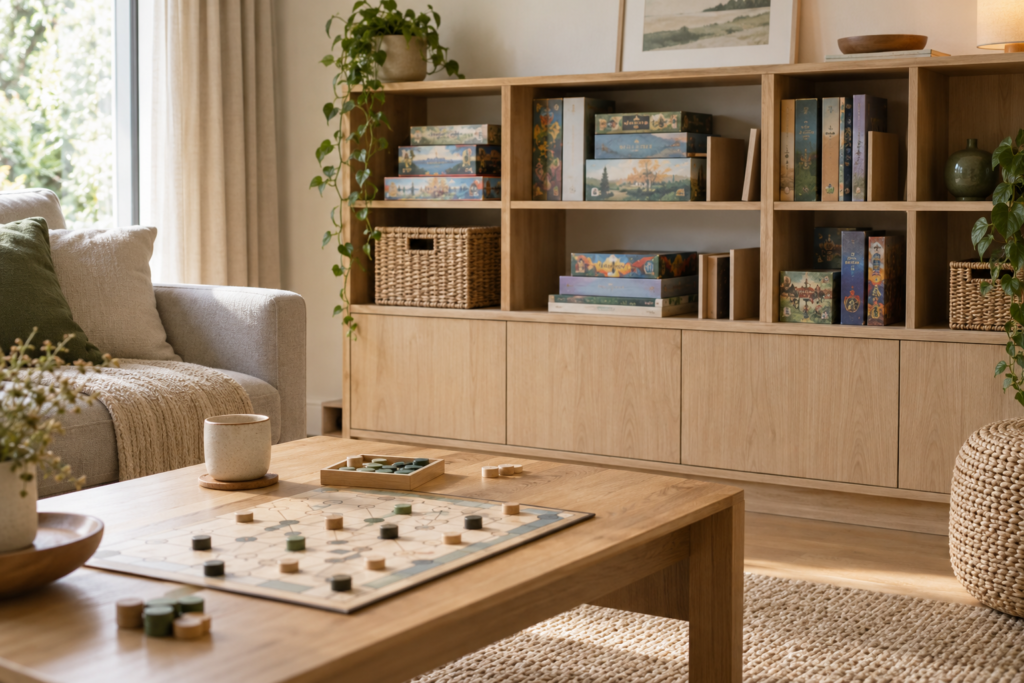
Living room board game storage ideas can help keep family games accessible without allowing colorful boxes, cards, dice, and small pieces to take over your shelves. Board games are often stored in the living room because that is where families and guests actually play them, but collections can quickly become difficult to manage.
The best system keeps games easy to identify, simple to remove, and convenient to put away after game night. You do not necessarily need a dedicated game room or large storage unit. Existing cabinets, bookcases, drawers, baskets, and console furniture can often handle a useful collection.
These 12 practical ideas can help you organize board games while maintaining a comfortable, uncluttered living room.
Table of Contents
- Why Organize Board Games in the Living Room?
- 12 Living Room Board Game Storage Ideas
- How to Choose the Right Storage Method
- How to Organize Your Board Game Collection
- How to Keep Small Game Pieces Organized
- Common Board Game Storage Mistakes
- Frequently Asked Questions
- Final Thoughts
Why Organize Board Games in the Living Room?
Board games are easier to use when you can quickly see what you own. When boxes are buried behind unrelated items or stacked in unstable piles, choosing a game can become unnecessarily difficult.
A dedicated storage zone also makes cleanup easier. Instead of leaving games on the coffee table because nobody knows where they belong, each box can return to a predictable shelf, cabinet, or basket.
Organization becomes even more important when games contain cards, tokens, dice, or other small components that can easily become separated from the main box.
If electronics are creating clutter in the same room, our living room charging station organization ideas can help you create a separate organized zone for devices and cables.
12 Living Room Board Game Storage Ideas
1. Dedicate One Cabinet to Board Games
An existing living room cabinet can provide one of the cleanest board game storage solutions. Closed doors hide colorful packaging while keeping the collection close to the area where games are normally played.
Arrange boxes so frequently used games are easiest to reach. Reserve higher or deeper shelves for games that come out less often.
2. Store Game Boxes Vertically
Some board game boxes can be arranged vertically like books, making individual games easier to remove without lifting an entire stack.
Before using this method, check that the box closes securely and that internal components will remain appropriately contained. Games with loose pieces may need additional internal organization before vertical storage works well.
3. Use a Low Console Cabinet
A media console or low storage cabinet can provide useful board game space without adding another piece of specialized furniture.
Keep games in one section and electronics or media accessories in another. Dividing the cabinet by category prevents game pieces from becoming mixed with cables, remotes, and other living room items.
4. Organize Games by Frequency of Use
Put family favorites at eye level or on the easiest shelf to reach. Games used only for parties or special occasions can occupy secondary storage positions.
Organizing by actual use is often more practical than arranging everything alphabetically or by box color.
5. Use Baskets for Small Games
Card games and compact travel games can disappear among larger boxes. A labeled or visually distinct basket can keep these smaller items together.
Place the basket on a shelf or inside a cabinet so you can pull out the entire category when choosing a quick game.
6. Create a Family Game Shelf
If your living room already has a bookcase, dedicate one or two shelves specifically to games. This keeps the collection visible and can encourage family members to use it more often.
Avoid overcrowding the shelf. Leaving enough room to remove each box makes the system much easier to maintain.
7. Use Cube Storage for Game Categories
Cube storage can separate a larger collection into manageable groups. One cube might hold children’s games, another strategy games, and another cards or puzzles.
Use bins selectively rather than hiding every game. Larger boxes may be easier to identify when stored directly on the shelf.
8. Keep Children’s Games on Lower Shelves
When age-appropriate games are intended for children to access independently, lower storage can make selection and cleanup easier.
Consider the age of the child, the game contents, and any manufacturer safety information. Games containing small parts should be kept appropriately away from children for whom those components present a hazard.
9. Use a Storage Ottoman Carefully
A storage ottoman can hold lightweight games while serving another purpose in the living room. It is especially useful when wall storage is limited.
Do not overfill the compartment. Games at the bottom should remain reasonably easy to retrieve without unloading everything above them.
10. Create a Dedicated Game-Night Basket
If your household repeatedly plays the same few games, keep those favorites together in an accessible basket or cabinet section.
This creates a simple game-night zone while the rest of the collection remains stored elsewhere. Rotate the selection occasionally to encourage variety.
11. Repair Damaged Boxes Before Storage
Torn corners and loose box lids make collections harder to stack and increase the chance of losing pieces. Minor box damage can often be addressed before returning the game to storage.
If the original box is no longer functional, use an appropriately sized replacement container and clearly identify which game it contains.
12. Declutter Games Your Household No Longer Plays
Board game collections can grow quietly over many years. Before buying additional shelving, review games that have not been used for a long time.
Keep favorites and games you realistically expect to play. Suitable complete games that are no longer wanted may be donated, passed to friends or family, or handled according to local reuse options.
How to Choose the Right Storage Method
Begin by looking at the size of your collection. A dozen games may fit easily into an existing cabinet, while a much larger collection may require several shelves or organized zones.
Next, consider where games are normally played. Storage near the coffee table or main seating area makes both setup and cleanup easier.
Think about visibility as well. Open shelves make it easy to browse the collection, while closed cabinets create a calmer visual appearance.
You can also combine both methods. Keep attractive or frequently used games visible and place less frequently used boxes behind cabinet doors.
How to Organize Your Board Game Collection
Start by gathering the entire collection into one area. Check that boxes contain their expected components and set aside anything that needs repair or sorting.
Next, group games in a way that matches how your household uses them. Possible categories include family games, children’s games, party games, strategy games, card games, or frequently played favorites.
Choose one primary living room storage area and place the most frequently used games in the easiest positions to reach.
After game night, return each game to the same location. A storage system that is easy to reset is far more likely to remain organized.
How to Keep Small Game Pieces Organized
Cards, tokens, dice, and other small components are often the hardest part of board game organization. Before storing a game, make sure loose components are properly contained inside its box.
Use the inserts, bags, trays, or storage methods supplied with the game whenever they work well. For games that no longer have useful internal storage, small reusable containers or bags may help separate components, provided they fit safely inside the box and are appropriate for the contents.
Keep each game’s components with that game rather than creating one general container for miscellaneous dice and tokens. This reduces confusion when the game is opened again.
Small game components may present choking hazards for young children. The U.S. Consumer Product Safety Commission provides general toy-safety guidance. Always follow the age recommendations and warnings supplied with individual games.
Common Board Game Storage Mistakes
One common mistake is creating very tall horizontal stacks. The game you want often ends up at the bottom, making the entire stack inconvenient to use.
Another mistake is mixing small card games with unrelated living room items. A dedicated basket or drawer section can prevent them from disappearing.
Avoid storing games in locations exposed to unnecessary moisture or other conditions that could damage cardboard boxes and paper components.
Finally, do not buy more storage simply because the collection has outgrown its current space. Decluttering games that are no longer used may solve the problem more effectively.
Frequently Asked Questions
What is the best way to store board games in a living room?
Closed cabinets, bookcases, console storage, cube shelves, and baskets can all work. Choose a solution that keeps games close to where they are played and makes individual boxes easy to access.
Is it okay to store board games vertically?
Some games can be stored vertically if their boxes close securely and their components remain contained. Check each game individually because loose internal pieces may shift when the box is turned upright.
How do I organize a large board game collection?
Group games by frequency, type, or intended players, then assign each group a defined shelf or cabinet section. Keep frequently played games in the most accessible locations.
How can I hide board games in my living room?
A media console, closed bookcase, sideboard, storage ottoman, or other cabinet can keep game boxes out of sight while remaining convenient.
How should I store small card games?
Keep them together in a small basket, drawer organizer, or dedicated shelf section so they do not become lost between larger game boxes.
How do I stop board game pieces from getting lost?
Return all components to the correct game immediately after play. Use the game’s original insert or suitable internal containers to keep cards, dice, and tokens separated inside the box.
Final Thoughts
The most useful living room board game storage ideas make it easier to enjoy your collection rather than simply hiding it. Games should be easy to choose, remove, play, and return when the evening is over.
Start with furniture you already have, give frequently played games the most accessible positions, and create smaller zones for cards and compact games.
With a simple storage system and occasional decluttering, your board game collection can remain part of family life without becoming permanent living room clutter.