
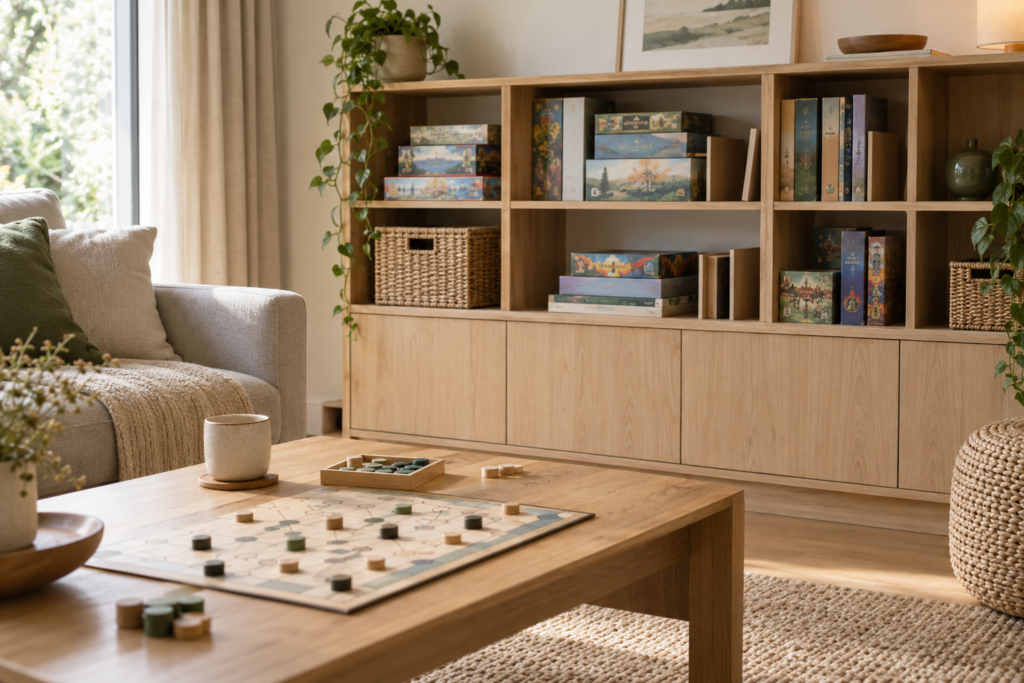
Board games bring people together, but boxes in different shapes and sizes can quickly overwhelm a living room. Oversized games may not fit standard shelves, frequently used boxes are often left on tables, and small cards or pieces can easily become separated.
These living room board game storage ideas balance accessibility, protection, and visual order. The goal is to create a system that makes games easy to select and return without allowing the collection to dominate the room.
Table of Contents
1. Living Room Board Game Storage Ideas: Dedicate a Bookcase Shelf
Reserve one or two bookcase shelves specifically for games instead of spreading boxes across several areas. Keeping the collection together makes it easier to see what you own and prevents games from becoming mixed with unrelated household items.
Place heavier boxes on lower shelves and lighter games above them. Confirm that each shelf can support the combined weight, and avoid stacking boxes so high that removing one causes the rest to fall.
2. Store Games Inside a Closed Cabinet
A cabinet with doors keeps colorful packaging from creating visual clutter. It is especially useful in a calm or minimalist living room where open shelves are reserved for books and decor.
Adjustable shelves allow you to accommodate both compact card games and taller boxes. Measure the largest games before setting shelf heights, and leave enough clearance to remove each box without damaging its corners.
3. Use a Storage Ottoman
A storage ottoman can hold a small game collection while also providing seating, a footrest, or a soft alternative to a coffee table. It works particularly well for games used regularly during family evenings.
Use shallow bins or dividers inside the compartment so boxes do not slide and crush one another. Check the manufacturer’s weight limits before anyone sits on the ottoman, and avoid overfilling it if the lid becomes difficult to close.
4. Add Baskets to a Cube Organizer
Cube organizers provide flexible compartments for board games, card games, puzzles, and accessories. Boxes can remain visible in some cubes while baskets conceal smaller or less attractive items in others.
Assign one basket to travel games, another to card decks, and a third to loose accessories. Simple categories make cleanup faster and help everyone understand where each item belongs.
5. Organize Games Vertically
Storing sturdy board game boxes vertically can make individual titles easier to remove because you do not have to lift an entire stack. Magazine holders or shelf dividers can prevent boxes from leaning.
Before using this method, secure internal pieces in resealable bags or small containers. Some boxes open easily when placed upright, so elastic bands designed for board games may provide additional support without damaging the packaging.
6. Keep Small Games in Labeled Bins
Small card games can disappear behind larger boxes or create untidy piles. Place them together in a shallow bin that can be removed from the shelf whenever someone wants to choose a game.
Use broad categories rather than creating a complicated label for every title. Categories such as quick games, children’s games, and card games remain useful even as the collection changes.
7. Choose a Coffee Table With Drawers
A coffee table with drawers keeps frequently played games close to the main seating area. Shallow drawers are suitable for compact boxes, score pads, dice, cards, and pencils.
Use drawer dividers to stop small items from shifting whenever the drawer opens. Reserve the table for a limited selection rather than forcing the entire collection into furniture designed for everyday living-room essentials.
8. Use the Lower Section of a Media Console
The lower cabinets of a media console may provide convenient storage when they are not occupied by electronics. Games kept here remain close to the seating area while staying hidden behind doors.
Do not block ventilation around electronic equipment or place games against warm devices. Keep cables separate from paper components, and leave clear access to outlets and media controls.
9. Protect Loose Pieces With Small Containers
Missing pieces can make an otherwise complete game difficult to use. Store tokens, dice, cards, and miniature components in resealable bags or small lidded containers inside the original box.
Keep the instructions with the correct game and check the floor after every session. A small divided accessory case can hold shared items such as timers, replacement dice, pencils, and scoring supplies.
10. Create a Family Game Station
A dedicated game station can combine storage with a clear playing surface. Use a compact cabinet or console near the dining table or living-room seating and keep the top mostly empty.
Store the most frequently played games between waist and eye level, with less-used titles above or below. This arrangement makes spontaneous game nights easier without permanently sacrificing the room’s main surfaces.
11. Rotate Games Seasonally
A large collection does not need to remain visible throughout the year. Keep a manageable selection in the living room and store less-used games in a dry closet or another protected area.
Rotate titles every few months or before holidays and family visits. A smaller active collection is easier to organize and may encourage people to notice games they have not played recently.
12. Declutter Incomplete or Unused Games
Review the collection before purchasing more organizers. Identify games with missing essential pieces, damaged components, duplicate versions, or rules that no longer suit the household.
Donate complete games that are no longer played, recycle eligible packaging where local facilities permit, and keep sentimental titles only when you genuinely value them. Effective living room board game storage ideas begin with a collection that fits the available space.
Should Board Games Be Stored Vertically or Horizontally?
Both methods can work. Horizontal storage supports fragile or loosely packed boxes, but tall stacks make lower games difficult to reach. Vertical storage improves access but requires secure lids and contained components.
Use the method that suits each game rather than applying one rule to the entire collection. Store heavy, oversized, or delicate boxes flat, while sturdy standard-size boxes may work well vertically with shelf dividers.
Keep Tall Storage Furniture Secure
Tall bookcases and cube organizers should remain stable, particularly in homes with children. Place heavier games near the bottom and avoid encouraging anyone to climb shelves to reach a favorite title.
Follow the furniture manufacturer’s anchoring instructions. The U.S. Consumer Product Safety Commission’s Anchor It guidance provides additional information about reducing furniture tip-over risks.
Final Thoughts
Practical living room board game storage ideas should make games easier to enjoy, not simply hide them. Closed cabinets reduce visual clutter, while bookcases, cube organizers, ottomans, and drawers keep frequently used titles within reach.
Protect loose components, keep heavy boxes low, and organize the collection according to how often each game is played. For help arranging shelves that also hold books and decor, explore our living room bookshelf organization ideas.
A clearly defined storage area and a simple return routine can keep the collection complete, accessible, and ready for the next game night.