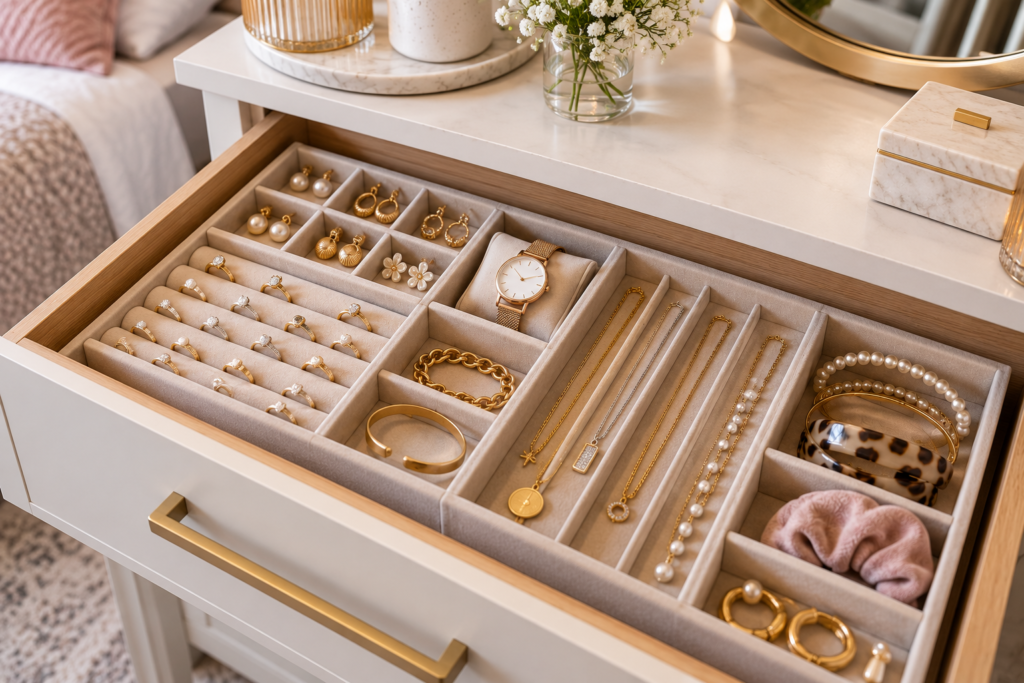
Start here: Good bedroom jewelry drawer organization ideas begin with three checks: does the insert fit the closed drawer, does it suit the pieces you own, and can you remove one piece without moving the others? This guide covers the inside of a drawer. For boxes, wall storage and choosing a bedroom location, use our complete jewelry storage guide.
Start with paper templates and containers you already have. Buy inserts only after the layout passes the fit and retrieval checks below. A drawer with many tiny sections can still be the wrong organizer for a collection dominated by necklaces or rigid bangles.
Table of Contents
- Measure and test the fit
- Choose the right insert
- 12 practical drawer decisions
- Test capacity and daily access
- Material-specific storage care
- Troubleshoot a layout that fails
- Frequently asked questions
- Your next step
Measure and Test a Jewelry Drawer Before Buying Inserts
- Measure clear width and depth: measure inside the drawer, including any taper or obstruction. Compare these with the organizer’s outside dimensions, including its rim, feet and handles.
- Check closed clearance: the drawer side height is not necessarily the height available beneath the frame. Test the tallest loaded compartment gently; stop if anything catches. Do not force the drawer closed.
- Check reach: open the drawer normally and mark the area you can see and reach. A tray may fit at the back but remain awkward to use if the drawer does not extend fully.
- Mock up the footprint: cut paper rectangles for trays, then place representative pieces in their proposed zones. Include their clasps and any pouch or box that will stay in the drawer.
A worked tray-fit example
Illustrative calculation, not a tested product: suppose the clear drawer base measures 42 × 32 cm. Two trays with outside dimensions of 20 × 30 cm use 40 cm of width and 30 cm of depth, leaving 2 cm in each direction. If their rims make them 21.5 cm wide, the pair needs 43 cm and will not fit. Internal compartment measurements cannot establish the outside fit.
Height needs a separate check. Two trays that are each 3 cm high may exceed 6 cm when stacked because their feet and rims affect the loaded height. Measure the actual assembled stack with its tallest piece in place; do not rely on adding catalogue heights.
Choose an Insert for Your Collection
Compare the storage method with the item that causes the problem. An insert that protects rings may waste most of its space if you mainly own long necklaces.
Scroll sideways to read the full table.
| Method | Choose it when | Check before buying |
|---|---|---|
| Ring slots | Rings need separate, visible positions | Thick bands and large settings must fit without pressure |
| Small open compartments | Earring pairs and backs become mixed | You can lift a pair out without emptying its neighbors |
| Long channels | Fine chains tangle together | The chain fits loosely; do not stretch it to fit |
| Removable boxes or pouches | A piece needs its own protective storage | Loaded height, opening access and material-specific care |
| Stacked trays | There is spare height and occasional jewelry below | The loaded stack clears the frame; lifting it does not disturb loose pieces |
12 Bedroom Jewelry Drawer Organization Ideas to Apply Selectively
1. Map the Collection Before the Compartments
Count pairs of earrings, rings, watches and necklaces separately. Note oversized pieces. A tray with 20 small cells does not provide 20 useful spaces if half your collection cannot fit inside them.
2. Match Ring Slots to the Largest Ring
Check the widest band and tallest setting first. Use a separate padded compartment if a slot grips too tightly or neighboring settings touch. Do not use extra pressure to gain another space.
3. Keep Each Earring Pair and Its Backs Together
Give each pair a visible position. Small studs may suit a dedicated compartment; hoops need a wider footprint. Avoid filling cells so deeply that pairs disappear beneath others.
4. Give Fine Necklaces Separate Channels
Lay chains loosely without pulling them taut. If a necklace cannot fit comfortably, choose another protective storage location rather than folding several chains into one crowded cell.
5. Test Bracelets on the Support You Will Use
A rigid bangle and a flexible bracelet need different space. Test any roll or cushion with the piece on it, including closure access and loaded height. Use a flat compartment when a support creates pressure or prevents closing.
6. Stack Only What You Can Lift Easily
Put occasional pieces below daily pieces. If both layers are used every morning, two shallow locations may be easier than a stack. Secure stacking matters more than filling every centimeter of height.
7. Put Daily Pieces in the Exposed Front Area
Place your regular watch, earrings or ring where the partly opened drawer reveals them. Judge this from the actual opening, not from how the drawer looks when completely removed.
8. Retain Protective Boxes Where They Solve a Problem
A supplied box or suitable pouch can remain inside a drawer if it fits and suits the piece’s care requirements. Do not discard protective packaging simply to make every compartment look identical.
9. Check Usable Capacity by Category
Count suitable positions, not all cells. Twelve cells may hold twelve earring pairs separately, but an oversized pair could need a different section. Include pieces being worn so the layout still works when the full collection returns.
10. Separate Watches from Fine Chains
Allow each watch its own footprint and keep heavier cases away from delicate jewelry. Cushions are optional; they are useful only if the watch and support fit without strain.
11. Stop Trays Moving Without Wedging Them
Open and close the drawer gently several times. If trays slide, reconsider their arrangement or use a suitable non-slip base. Do not wedge an oversized insert against the drawer sides or obstruct its runners.
12. Store Special Pieces According to Their Needs
An everyday drawer is not automatically appropriate for every valuable or sentimental piece. Decide separately whether an item needs more secure storage or advice from its jeweler. Convenience should not override those requirements.
Test Capacity and Daily Access Before Buying More
Load the mock-up with the collection that actually belongs here. Pick up a daily item, put it back, then try an occasional piece from the rear or lower tray. A successful layout allows retrieval without tangling chains, scraping settings or unloading unrelated items.
Repeat after returning the jewelry you were wearing. If it no longer fits, move a category to another suitable location or change compartment sizes. Extra layers are useful only when the lower contents remain reasonably accessible. For a shared drawer, make each person’s daily area clear.
Keep lotions, cosmetics and unrelated bedside objects elsewhere. Our nightstand drawer guide covers a separate home for bedside essentials.
Follow Material-Specific Storage Care
The Gemological Institute of America’s jewelry-care guidance recommends protective storage and notes that sterling silver can benefit from an anti-tarnish bag or cloth. It also cautions that very dry conditions can be unsuitable for pearls and opals. Do not treat one drawer insert or a moisture absorber as a universal solution for every material.
For pearls, GIA advises a soft pouch or case and protection from rough objects and chemicals in its pearl-care guidance. Follow the maker or jeweler’s instructions for treated stones, delicate settings and individual pieces. This is a storage-planning guide, not a claim that these organizers have been personally tested.
Troubleshoot the Failure Before Adding Another Tray
- Drawer catches: check loaded height, tray rims and protruding pieces; remove the obstruction rather than pushing harder.
- Chains still tangle: provide separation or reduce the number sharing a channel.
- Pieces disappear: compartments may be too deep or overfilled; make the contents visible.
- Daily access is slow: move daily pieces out of a lower layer or inaccessible rear section.
Frequently Asked Questions
Do I need a fitted jewelry organizer?
No. Suitable small boxes or protective pouches may solve the problem. Test their footprint, height and access before buying a replacement.
Can I stack trays in a shallow drawer?
Only if the actual loaded stack clears the frame and the lower layer is easy enough to access. Catalogue heights alone are not a fit test.
How much empty space should I leave?
There is no fixed percentage. Leave enough room to retrieve and return each piece without pressing against other jewelry, including the pieces normally being worn.
Your Next Step
Measure the drawer, mock up one layout and try the full collection. Keep the arrangement that passes fit, retrieval and material-care checks. Purchase only the insert that resolves a remaining problem.