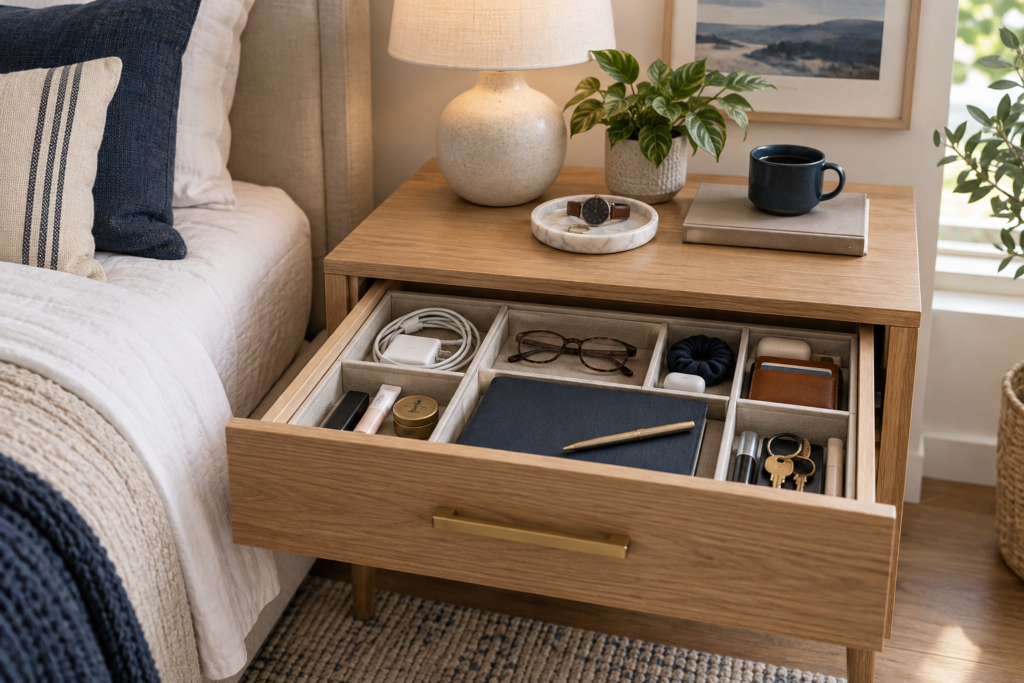
Bedroom nightstand drawer organization ideas should give the items you use at bedtime one accessible layer. Start with the objects that belong beside this bed, measure their containers and loaded height, then divide the drawer. A small drawer can work without a matching organizer set.
This guide covers bedside storage and unplugged accessories. The fit example uses illustrative measurements, not a tested nightstand.
Table of Contents
- Plan one layer: fit example
- 12 bedroom nightstand drawer organization ideas
- Quick setup method
- Mistakes to avoid
- Frequently asked questions
Plan One Layer Before Buying Dividers
For bedroom nightstand drawer organization ideas, internal fit matters more than matching containers. Measure the usable width and depth, the narrowest opening, and the vertical clearance beneath the structure above the drawer. Measure at the tightest point rather than assuming the drawer is square.
Scroll sideways to read the full table.
| Item group | Position and check |
|---|---|
| Glasses or watch | A dedicated, appropriately lined space near the front. Check the case and tray together so nothing is crushed on closure. |
| Notebook and pen | One flat section sized for the notebook. Keep the pen beside it rather than under a stack. |
| Unplugged cables | A separate shallow compartment. Include connectors when checking width and height; keep cables out of runners. |
| Tissues or personal-care items | A compartment that fits the actual package and lets you lift it out. Keep leak-prone containers away from paper and electronics. |
| Backups and occasional items | Move these elsewhere if they force active items into layers. An organizer cannot compensate for an unlimited inventory. |
Worked example: allow for the tray walls
Illustrative dimensions: a drawer is 34 cm wide, 28 cm deep and has 6 cm of usable vertical clearance. Two trays are each 17 cm wide externally. Their total width is 34 cm, leaving no lateral gap. That arithmetic alone does not establish a usable fit; drawer irregularities, tray rims and the removal path still need checking.
If two alternative trays are 15 and 16 cm wide, they occupy 31 cm and leave 3 cm total across the drawer. That remaining space is available to distribute after testing; it is not a required clearance. A 7 cm-high glasses case still fails the 6 cm vertical limit even if the tray itself is only 3 cm high.
Use paper outlines for the tray footprints, then check the outside tray dimensions and the loaded contents. The useful result is one accessible layer that closes normally, not a fixed percentage of empty space.
12 Smart Bedroom Nightstand Drawer Organization Ideas
1. Use Adjustable Drawer Dividers
Expandable dividers create custom sections without wasting space. Make one narrow lane for pens and lip balm, one for glasses, and one for larger items. Choose low-profile dividers so the drawer closes smoothly.
2. Add a Soft-Lined Valet Tray
A small felt or fabric-lined tray protects watches, rings, and glasses from scratches. Place it near the front for easy access. Avoid mixing jewelry with metal keys or loose charging plugs.
3. Separate Unplugged Charging Accessories
Store disconnected cables and adapters in one compartment, with loose coils rather than tight bends. Keep all parts inside the drawer, clear of its runners and closing edge. Do not route a live charging cable across an ordinary drawer edge.
Charge devices in a suitable location following their manufacturer’s instructions. For example, Apple’s iPhone safety guidance calls for ventilation during charging and warns against placing connected devices or chargers under pillows or blankets. A furniture drawer is not automatically a charging enclosure. Purpose-built powered furniture has its own installation and ventilation requirements.
4. Keep Restricted Items Out of General Compartments
An ordinary drawer and a small lidded box do not establish secure storage. Keep medicines and other items requiring restricted access in an appropriate place following their own storage instructions. Do not treat convenient bedside access as the only criterion.
5. Use Small Recycled Boxes
Sturdy phone boxes, gift boxes, and clean cardboard containers can become free drawer organizers. Compare their external dimensions and keep enough working room to remove items and open the drawer normally. Cover mismatched boxes with neutral paper if you want a coordinated look.
6. Keep Only One Current Book
Store the book or journal you are actively using in the drawer and move finished books to a shelf. This prevents the nightstand from becoming a second bookcase and keeps the drawer easy to open.
7. Separate Morning and Evening Essentials
Place evening items toward the front and morning items toward the back or opposite side. This simple zoning reduces searching when you are tired and makes it easier to reset the drawer each day.
8. Use Clear Containers for Tiny Items
Transparent containers work well for earplugs, hair ties, spare buttons, and other small pieces. Lids prevent items from migrating between compartments. Choose shallow containers so you can see everything at a glance.
9. Add a Drawer Liner
A washable non-slip liner keeps organizers from sliding and protects the drawer surface. Cut it precisely to size and choose a light neutral color that makes small objects easier to spot.
10. Limit Backup Supplies
Keep only one backup of frequently used bedside items such as tissues or hand cream. Store bulk supplies elsewhere. A nightstand drawer works best as an active-use zone rather than long-term storage.
11. Label Hidden Compartments
Small labels help every household member return items correctly. Use simple category names such as Charging, Reading, Personal Care, and Sleep. Place labels inside the drawer for a discreet appearance.
12. Schedule a Monthly Reset
Once a month, remove trash, return wandering items, wipe the liner, and check cables or batteries. A five-minute reset prevents clutter from rebuilding and keeps the system useful.
A Quick Five-Step Setup
- Empty and clean the entire drawer.
- Group items by purpose and remove anything unrelated to sleep or morning routines.
- Measure the drawer and test containers before purchasing more.
- Place frequent items at the front and delicate items in lined sections.
- Test the drawer with normal contents: remove and return each item, then close it without pushing anything down. Leave the working room this requires.
For more calm-space inspiration, explore our bedroom organization guides and other practical ideas on Nestivoza.
Nightstand Organization Mistakes to Avoid
Do not stack items until the drawer closes only under pressure. Check tray rims, cases and bottles as a loaded arrangement. Keep open drinks and leak-prone products away from paper and electronics, and reserve the drawer for unplugged accessories unless the furniture is specifically designed and installed for powered use.
Frequently Asked Questions
What belongs in a nightstand drawer?
Keep a small group of items used at bedtime or immediately after waking, such as glasses, a book, a notebook, tissues, earplugs, and charging cables.
How do I organize a very small bedside drawer?
Use shallow boxes, vertical dividers, and strict limits. Give each essential one dedicated spot and relocate backups or rarely used items.
How often should I clean the drawer?
A quick monthly reset and a deeper seasonal clean are usually enough. Wipe spills immediately and remove expired products as soon as you notice them.
Check the Drawer in Use
Retrieve your glasses, notebook and one accessory, then return them. Each should have a visible place without moving another layer. If one item repeatedly lands on the nightstand instead, reconsider its compartment or whether it belongs in the drawer.
For a larger reading collection, use the measured shelf-space method in our bedroom book storage guide. Keep this drawer focused on the items used here.