A living room often has to do several jobs at once. It may be the place where adults relax, guests gather, children play, and the whole family spends time together. When toys become part of that shared space, even a comfortable room can quickly start to feel cluttered.
The best living room toy storage ideas do more than hide toys before guests arrive. They create simple, predictable places where children and adults can find what they need and put it away again. The right system can also help preserve valuable floor space and keep the room feeling like a living area rather than a permanent playroom.
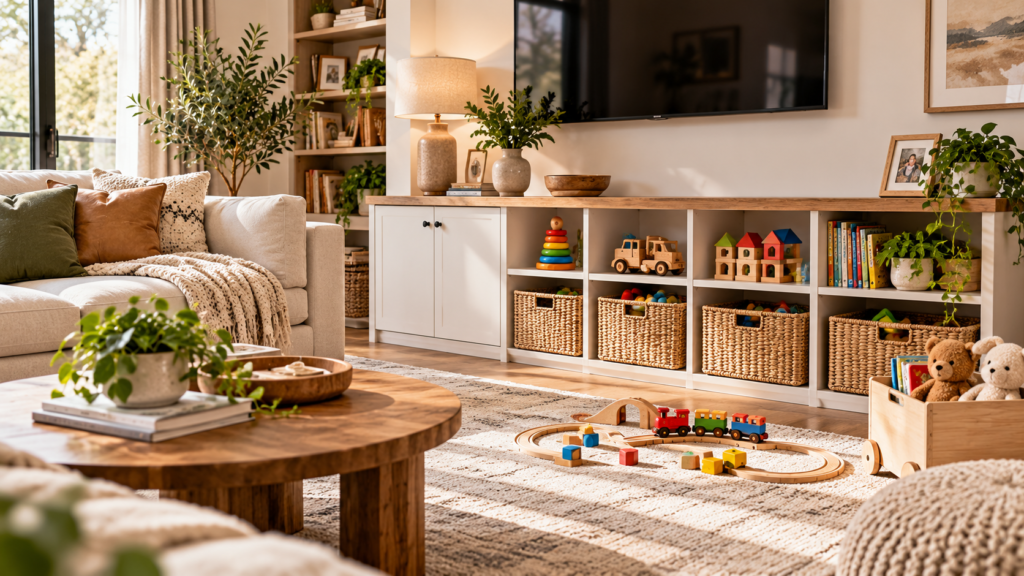
From baskets and cube organizers to closed cabinets and toy rotation, these 12 practical ideas can help you create a family-friendly living room that is easier to reset at the end of the day.
Table of Contents
- Before Organizing Living Room Toys
- 12 Living Room Toy Storage Ideas
- Toy Storage for Small Living Rooms
- Space-Specific Furniture and Vertical Storage
- How to Choose the Right Toy Storage
- Toy Storage Safety Considerations
- Common Toy Storage Mistakes
- Frequently Asked Questions
- Final Thoughts
Before Organizing Living Room Toys
Before buying another basket or storage unit, gather the toys that regularly end up in the living room. Seeing everything together makes it easier to understand what actually needs a home.
Separate the collection into simple groups such as building toys, dolls or figures, vehicles, puzzles, art supplies, soft toys, and miscellaneous items. Remove broken pieces and toys that are no longer appropriate or used.
Next, decide how much of the collection genuinely needs to stay in the living room. The room does not have to hold every toy your household owns. Keeping a smaller active selection can make both playtime and cleanup easier.
Finally, look at the room from a child’s perspective. Storage intended for independent cleanup should be easy to understand and, where appropriate for the child’s age, accessible without climbing onto furniture.
12 Smart Living Room Toy Storage Ideas
1. Create One Dedicated Toy Zone
One of the simplest ways to control toy clutter is to establish a clear boundary.
Instead of allowing toys to spread across every cabinet, table, and corner, choose one section of the living room as the primary toy zone. This might be beside a sofa, beneath a window, inside a media unit, or along one wall.
The storage itself can vary, but the boundary matters. When both adults and children know where living room toys belong, cleanup becomes much more straightforward.
Keep the zone proportional to the room. If toys outgrow the designated area, treat that as a signal to rotate, relocate, or reassess the collection rather than continually adding containers.
2. Use Low Baskets for Everyday Toys
Open baskets are useful for toys that are played with frequently because they require very little effort to use.
Choose broad categories rather than assigning a separate basket to every tiny toy type. One basket for toy vehicles and another for soft toys, for example, may be easier to maintain than a complicated sorting system.
Low baskets can also slide beneath suitable consoles or fit onto lower shelving, helping the living room retain a more intentional appearance.
Avoid overfilling them. Children should be able to remove and return toys without emptying the entire container onto the floor.
3. Add Cube Storage With Removable Bins
A cube organizer can combine open and concealed storage in one compact footprint.
Use removable bins for visually busy categories and leave selected cubes open for larger toys or attractive children’s books. Keeping similar items together makes the unit easier to maintain.
For younger children, simple picture labels can be more useful than text-only labels. A small image of blocks or toy cars provides a visual cue for where things belong.
If you use a freestanding storage unit, follow the manufacturer’s assembly and anchoring instructions carefully.
4. Choose a Closed Cabinet for Visual Calm
Not every toy needs to remain visible.
A closed cabinet can help a shared living room transition from playtime to adult relaxation without requiring toys to leave the room entirely. Inside, use bins or shallow containers so the cabinet does not become one large mixed pile.
Place frequently used categories in the easiest-to-reach areas and reserve higher or less convenient sections for items handled by adults.
Closed storage works particularly well when your living room already contains substantial open shelving and you want to reduce visual clutter.
5. Use a Storage Ottoman for Soft Toys
A storage ottoman can provide seating or a footrest while also creating concealed storage.
It is particularly useful for lightweight, bulky items such as stuffed animals, soft toys, or dress-up textiles. These items take up considerable shelf space but usually do not need complex sorting.
Before using an ottoman for children’s items, check its construction, stability, lid mechanism, ventilation where relevant, and the manufacturer’s safety instructions. Do not assume every storage ottoman is designed for unsupervised child access.
The same hidden-storage principle can work elsewhere in the room. Our coffee table organization ideas include additional ways to keep frequently used living room items under control.
6. Dedicate the Lower Part of a Bookcase to Toys
If your living room already has a bookcase, you may not need another storage unit.
Reserve suitable lower shelves for children’s items while keeping adult books and decorative objects in other sections. Small bins can contain loose toys, while larger pieces can sit directly on the shelf when appropriate.
This creates a family-friendly storage system without allowing toys to dominate the entire bookcase.
If the bookcase is freestanding, make furniture stability a priority and follow appropriate anchoring instructions.
For ideas on keeping the rest of the shelving balanced and functional, see our living room bookshelf organization ideas.
7. Add Shallow Drawers for Small Toy Categories
Small pieces are often responsible for the messiest-looking toy areas.
Shallow drawers can make it easier to separate items such as building pieces, small figures, craft materials, or toy accessories. Because the drawer is not excessively deep, children and adults can see more of the contents without digging through a large bin.
Use only as many categories as your household can realistically maintain. A system with three understandable drawers is often more sustainable than fifteen highly specific compartments.
8. Use the Space Under Suitable Furniture
Some living rooms have unused space beneath a sofa, console, bench, or other raised furniture.
If clearance allows, a low-profile container can turn that space into discreet toy storage. This works especially well for flat puzzles, drawing supplies, or small collections that do not need to remain on display.
Measure the available height and depth before purchasing containers, including enough clearance to pull them out easily.
Containers should not obstruct vents, electrical equipment, moving furniture components, or normal walking paths.
9. Create a Children’s Book-and-Toy Corner
If play and reading often happen together, combine them into one purposeful corner.
A small book display, one or two toy baskets, and a comfortable floor area can establish a clear activity zone without converting the entire living room into a playroom.
Keep the number of items intentionally limited. A calm corner with a manageable selection can be more inviting than an overloaded wall of toys.
If your family already uses a reading area, our living room reading nook ideas can help you integrate books and comfortable seating into the room.
10. Rotate Toys Instead of Storing Everything at Once
Toy rotation is particularly valuable when living room storage is limited.
Keep a manageable selection accessible and store the remaining toys elsewhere. After a suitable period, swap some categories rather than continually adding more items to the active area.
This reduces the number of toys that need to be cleaned up each day and makes it easier to give every active item a defined home.
You do not need an elaborate schedule. A simple rotation whenever the current selection becomes overcrowded or loses interest can be enough.
11. Use Labels That Make Cleanup Easier
Labels are most useful when they help the person actually putting toys away.
For adults and older children, simple text labels may be enough. For younger children, pair a short word with a clear picture representing the category.
Keep categories broad and consistent. Labels such as “Cars,” “Blocks,” “Books,” and “Soft Toys” are easier to understand than an overly detailed classification system.
Labels also make it easier for caregivers and visitors to help reset the room without asking where every item belongs.
12. Keep One Quick-Cleanup Basket
Even the best organization system will occasionally face a rushed cleanup.
Keep one attractive basket for temporarily collecting stray toys before guests arrive or at the end of a busy evening. The important part is treating it as a temporary reset tool rather than permanent mixed storage.
Once there is time, return the contents to their actual categories.
This approach is similar to controlling other small living room items: give everyday clutter a boundary before it spreads. For non-toy essentials, our living room remote control storage ideas show how a defined home can simplify daily resets.
Toy Storage Ideas for Small Living Rooms
A small living room usually benefits more from controlling toy volume than from adding multiple storage units.
Start with one compact toy zone and choose storage that uses existing space efficiently. A lower bookcase section, a few baskets beneath suitable furniture, or a compact cube unit may be enough.
Look vertically as well as horizontally, but keep child-accessible items at appropriate heights. Higher storage can hold supplies or rotated toys that adults manage.
Multifunctional furniture can also help, provided it is appropriate for the household and used according to the manufacturer’s safety guidance.
Most importantly, avoid filling every available gap with toys. Leaving some open space can make a compact room feel calmer and makes cleanup easier.
Space-Specific Options for Furniture and Vertical Storage
Some living rooms have an awkward recess, unused wall, or furniture layout that makes standard baskets less effective. The following options can solve those specific problems, but they require careful measuring and, in several cases, secure installation.
Use Baskets Under a Console Table
A console table with clear space below can create a defined parking area for matching baskets. Measure the opening so containers slide in without scraping, and reserve the baskets for lightweight categories that are easy to return. Keep walkways clear and avoid baskets that project beyond the furniture.
Consider a Window Seat With Built-In Drawers
Where the room already has a suitable window-seat structure, drawers can provide concealed storage without adding another freestanding unit. This is a larger project, so confirm dimensions, ventilation or heating clearances, material suitability, and installation requirements with an appropriate professional before altering fixed furniture.
Add a Rolling Cart for Supervised Activities
A stable cart can hold art supplies, puzzles, or building sets that move between a storage area and the main table. Choose a design appropriate for the household, keep heavy items low, use wheel locks where provided, and return the cart to a safe parking position after use.
Use Picture Ledges for Children’s Books
Shallow ledges can display book covers and make a small reading selection easier to see. They are not a substitute for general toy storage. Install them securely according to the manufacturer’s instructions, place them at an appropriate height, and rotate a limited number of books rather than overloading the ledge.
Choose a Coffee Table With Enclosed Storage
A lift-top or drawer-style coffee table can conceal puzzles, games, or soft toys while keeping the adult living area visually calm. Check moving parts, stability, pinch points, and the manufacturer’s safety guidance before using it in a home with children.
Reserve Wall-Mounted Cabinets for Adult-Managed Storage
Securely installed wall cabinets can hold rotation stock or items that children should not access independently. Use professional installation when needed, follow load limits, anchor furniture as recommended, and avoid treating high storage as an invitation for children to climb.
How to Choose the Right Living Room Toy Storage
Match the Container to the Toy
Large soft toys may need a roomy basket, while tiny pieces benefit from smaller compartments or shallow drawers. Avoid forcing every category into identical containers simply for visual symmetry.
Consider Who Will Use the Storage
A system intended for independent child cleanup should be understandable and appropriately accessible. Items requiring adult supervision should be stored accordingly.
Prioritize Easy Resetting
If putting one toy away requires opening three boxes and rearranging a shelf, the system is unlikely to survive daily family life.
Choose storage that makes the correct action obvious and reasonably quick.
Balance Open and Closed Storage
Open baskets improve accessibility, while cabinets and opaque bins reduce visual clutter. Most shared living rooms benefit from a combination of both.
Measure Before Buying
Check width, depth, height, door clearance, walking space, and furniture placement before adding a storage unit. A container that technically fits may still make the room awkward to navigate.
Toy Storage Safety Considerations
Organization should never take priority over household safety. Storage furniture, bins, and toys should be appropriate for the children’s ages and used according to manufacturer instructions.
Furniture tip-over is an especially important consideration in homes with children. The U.S. Consumer Product Safety Commission advises consumers to anchor furniture such as dressers, bookcases, and other furniture that can tip over, and to place heavier items on lower shelves or drawers.
You can review the U.S. Consumer Product Safety Commission’s Anchor It! guidance for additional furniture tip-over prevention information.
Other practical considerations include:
- Follow age recommendations and warnings supplied with toys.
- Keep small parts away from children for whom they present a hazard.
- Do not place heavy storage containers where a child may pull them down.
- Keep walking paths and exits free from toys and containers.
- Check storage furniture and hardware periodically for damage or looseness.
- Follow manufacturer instructions for wall anchoring and installation.
- Avoid encouraging children to climb shelves or furniture to reach toys.
Common Living Room Toy Storage Mistakes
Buying Containers Before Sorting
If you buy organizers before understanding the collection, you may end up with containers that are too small, too large, or unnecessary. Sort first and shop second.
Creating Too Many Categories
An extremely detailed system can look impressive initially but become frustrating during daily cleanup. Use the fewest categories that keep the collection functional.
Using One Huge Toy Bin
A large bin hides clutter quickly, but small toys sink to the bottom and children may empty everything just to find one item. Divide frequently used categories when practical.
Keeping Too Many Toys in the Living Room
No organizer can make an unlimited collection fit comfortably into a limited space. Rotate or relocate toys when the active collection becomes difficult to manage.
Ignoring Furniture Safety
Tall storage furniture can create a tip-over hazard if not appropriately secured. Follow manufacturer instructions and recognized furniture-safety guidance.
Making Storage Difficult for Daily Use
A beautiful container is not useful if nobody can easily return toys to it. Prioritize function, accessibility, and simple cleanup over decorative perfection.
A Simple 10-Minute Living Room Toy Reset
A predictable routine can prevent small amounts of clutter from turning into a major cleanup project.
- Collect toys from the floor, sofa, and tables.
- Return large toys to their assigned locations.
- Sort loose pieces into their broad categories.
- Return children’s books to their shelf or display.
- Move toys that belong in another room out of the living room.
- Place any unidentified stray items in the temporary cleanup basket.
- Clear the main walking paths and seating areas.
When the storage system is simple, the reset should become faster with practice.
Frequently Asked Questions
1. How do I hide toys in my living room?
Closed cabinets, appropriate storage ottomans, drawers, and baskets inside shelving can reduce visual clutter. Keep frequently used toys accessible while using concealed storage for categories that do not need to remain visible.
2. How can I organize toys without a dedicated playroom?
Create one defined toy zone within the living room. A compact cube organizer, lower bookcase shelves, or several baskets can provide enough storage without turning the entire room into a play area.
3. What is the best toy storage for a small living room?
The best solution depends on the collection and layout, but compact vertical storage, existing furniture, low-profile containers, and toy rotation can reduce the amount of additional floor space required.
4. Are baskets good for toy storage?
Yes, especially for larger or frequently used toy categories. Choose appropriately sized baskets that are easy to handle and avoid making them so deep that small items become difficult to find.
5. How can I encourage children to put toys away?
Keep categories simple, provide clear homes for toys, and use picture labels when helpful. Storage that is appropriate for the child’s age and abilities can make cleanup easier to understand.
6. How many toys should I keep in the living room?
There is no universal number. Keep an amount that fits comfortably within the storage boundary you have chosen. If toys routinely overflow, rotate or relocate part of the collection.
7. How can I make toy storage look good in an adult living room?
Use a limited palette of baskets or bins, combine open and closed storage, and confine toys to a defined zone. The goal is not to disguise the fact that children live there, but to prevent toy storage from visually dominating the entire room.
Final Thoughts
The most effective living room toy storage ideas create a balance between family life and an organized shared space. You do not need to hide every toy or create a complicated system.
Start with one defined toy zone, keep the active collection manageable, and choose containers that match the size and frequency of use of each category. Baskets can simplify everyday cleanup, closed cabinets can reduce visual clutter, and toy rotation can prevent limited storage from becoming overloaded.
Most importantly, design the system around the people who actually use the room. When toys have clear, practical homes and the setup is easy to reset, the living room can support everyday play while still feeling comfortable, welcoming, and organized.