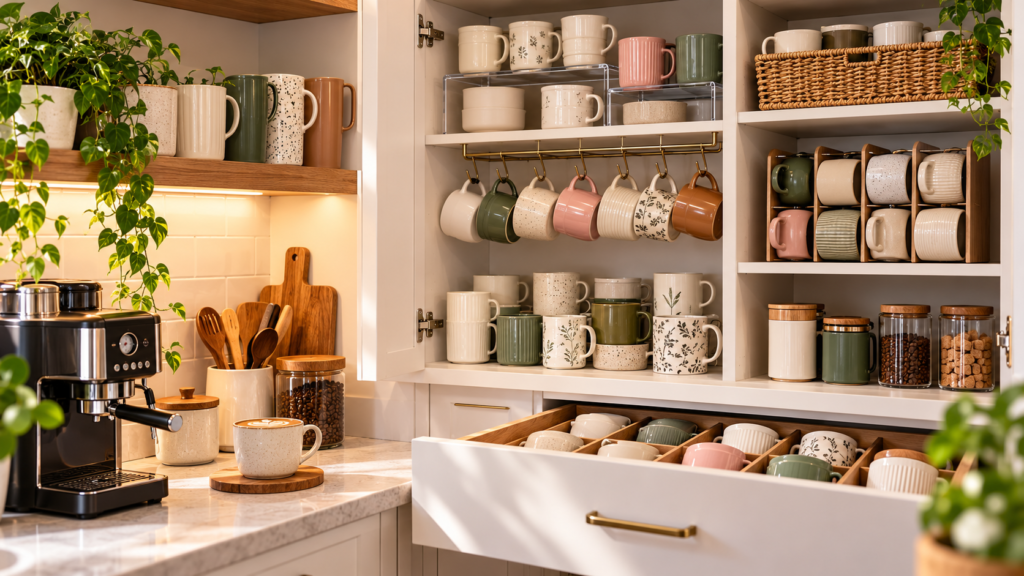
Coffee mugs have a habit of multiplying. A few everyday cups can quickly turn into an overcrowded cabinet filled with travel souvenirs, oversized mugs, matching sets, and favorites you reach for every morning.
The right kitchen coffee mug storage ideas can make that collection easier to use without taking over valuable cabinet or counter space. Instead of stacking mugs wherever they fit, a simple system can keep everyday cups accessible, protect favorite pieces, and make better use of shelves, walls, drawers, and other overlooked areas.
Whether you have a compact kitchen or an entire collection of mugs, these 12 practical ideas can help you create storage that feels organized, functional, and easy to maintain.
Table of Contents
- Before Organizing Your Coffee Mugs
- 12 Kitchen Coffee Mug Storage Ideas
- Alternative Storage for Awkward Cabinets
- How to Choose the Right Mug Storage System
- Coffee Mug Storage for Small Kitchens
- Common Coffee Mug Storage Mistakes
- Frequently Asked Questions
- Final Thoughts
Before Organizing Your Coffee Mugs
Start by taking your mugs out of the cabinet and looking at the entire collection. Separate the cups you use regularly from seasonal mugs, sentimental pieces, matching sets, and those you rarely choose.
Next, check their dimensions. Oversized mugs, espresso cups, tall travel-style cups, and standard coffee mugs do not necessarily fit the same organizer.
This is also a good time to remove chipped or damaged mugs and reconsider pieces that have not been used for a long time. A smaller, intentional collection is easier to organize than an overcrowded shelf.
Before returning mugs to storage, make sure they are clean and properly dry. The U.S. Food and Drug Administration recommends washing dishes and utensils with hot, soapy water as part of good kitchen hygiene.
12 Smart Kitchen Coffee Mug Storage Ideas
1. Create an Everyday Mug Shelf
The easiest storage system is often a dedicated section of an existing kitchen cabinet.
Instead of scattering mugs across several shelves, reserve one accessible area for the cups your household uses most often. Place everyday favorites near the front and less frequently used pieces toward the sides or higher shelves.
Keeping one clear mug zone also makes putting dishes away easier because every cup has an obvious destination.
2. Add a Shelf Riser Inside the Cabinet
Cabinets often waste a surprising amount of vertical space above short coffee mugs. A freestanding shelf riser can divide that height into two usable levels.
Place one row of mugs below the riser and another above it. This reduces the need for tall, unstable stacks and makes individual cups easier to remove.
Measure the cabinet and your tallest mugs before choosing a riser so both levels have enough clearance.
If crowded shelves are a recurring problem throughout the kitchen, our kitchen cabinet organization ideas offer more ways to make cabinet space work efficiently.
3. Install an Under-Shelf Mug Rack
An under-shelf rack can turn unused space beneath a cabinet shelf into dedicated mug storage.
Many versions allow mugs to hang by their handles while leaving the shelf surface available for other items. This can be particularly useful when cabinet shelves are tall but cannot easily be repositioned.
Check the rack’s dimensions and weight limits before installation, and make sure your mug handles fit securely without forcing them into place.
4. Use Hooks Under a Wall Cabinet
If cabinet interiors are already full, the underside of a wall cabinet may offer another option.
Properly installed mug hooks can keep a small collection accessible near a coffee station while freeing shelf space. They can also create an attractive display when the mugs coordinate with the kitchen.
Avoid overcrowding the hooks. Leave enough room between mugs so they do not knock against one another when you remove a cup.
Always use hardware appropriate for the mounting surface and expected load.
5. Build a Simple Coffee Station
Grouping mugs near the coffee maker can reduce unnecessary movement around the kitchen every morning.
A small shelf, cabinet section, or counter organizer can hold a practical number of everyday mugs alongside coffee-making essentials.
Keep the station focused. You do not need the entire mug collection beside the machine—only the pieces used regularly.
This approach works especially well when several household members make coffee throughout the day because the most frequently needed items stay together.
6. Store Mugs in a Deep Drawer
A deep kitchen drawer can be an excellent alternative to an upper cabinet, especially when reaching overhead shelves is inconvenient.
Arrange mugs in a single visible layer whenever possible. A nonslip drawer liner or suitable dividers can help reduce movement when the drawer opens and closes.
Check the drawer height carefully before using this method. Handles and rims should clear the drawer above without scraping.
7. Use a Countertop Mug Tree for Daily Favorites
A mug tree can work well for a small collection of cups used every day.
Its main advantage is convenience: mugs remain visible and within easy reach without occupying an entire cabinet shelf.
However, countertop storage works best when it remains intentionally limited. Filling every branch and surrounding the stand with extra mugs can make the counter look more cluttered rather than organized.
Choose a stable mug tree and distribute the weight evenly according to its design.
8. Turn a Small Open Shelf Into a Mug Display
Favorite mugs can double as decor when arranged neatly on a small open shelf.
This method is particularly effective for attractive matching sets, handmade ceramics, or a carefully edited collection. Arrange mugs with enough space between them to avoid a crowded appearance.
Open storage does require more regular dusting than a closed cabinet, so reserve it for mugs you actually enjoy displaying and using.
9. Organize Mugs by Size
Sometimes the problem is not the amount of cabinet space but the way different mug sizes are mixed together.
Group standard mugs, oversized cups, espresso cups, and other specialty pieces separately. Similar dimensions make shelf spacing easier to plan and reduce awkward gaps.
If adjustable shelves are available, position them according to the tallest item in each group rather than using identical spacing throughout the cabinet.
10. Keep Seasonal Mugs in Secondary Storage
Holiday and seasonal mugs do not need prime cabinet space all year.
Move them to a clearly labeled secondary storage location when they are out of season. This leaves the easiest-to-reach shelves available for cups used every week.
When the season changes, rotate the relevant mugs back into the everyday zone rather than adding them on top of an already full cabinet.
This simple rotation system is particularly helpful for households with large sentimental or holiday collections.
11. Use a Freestanding Mug Rack
A freestanding rack can add mug storage when wall cabinets are limited or when you want to keep cups near a coffee corner.
Depending on the design, a rack may sit on a countertop, narrow shelving unit, or dedicated beverage cart.
Choose one that holds mugs securely and fits the available surface without interfering with food preparation. In a small kitchen, every countertop organizer should justify the space it occupies.
12. Create an Occasional-Mug Zone on a Higher Shelf
Not every mug needs to be equally accessible.
Keep everyday pieces at a comfortable height and move rarely used souvenir mugs, special sets, or sentimental cups to a higher cabinet shelf.
This frequency-based approach prevents occasional items from competing with the mugs you reach for every morning.
If the higher shelf is deep, avoid creating several hidden rows. A shallow organizer or clearly defined sections can help you see what is stored there without unloading the entire cabinet.
Four Alternatives for Awkward Cabinets and Special Mugs
Standard shelves do not suit every kitchen or collection. The following options are most useful when the main 12 methods leave a specific gap; they should not be added simply to increase capacity.
Use a Peg Rail for a Small Everyday Set
A securely mounted peg rail can hold a limited number of frequently used mugs while keeping them visible. Check the rail, fasteners, mounting surface, peg spacing, and stated load capacity before hanging ceramic pieces. Position it where mugs will not be struck by cabinet doors or routine food preparation.
Try a Turntable on a Deep, Stable Shelf
A low-sided turntable can improve access when a deep corner makes the back row difficult to reach. Measure the cabinet and mug handles first, rotate it slowly, and avoid designs that allow cups to slide or collide. This option works best for a modest group of similar-size mugs rather than a crowded collection.
Evaluate a Cabinet-Door Rack Carefully
A door-mounted rack may use otherwise empty space, but only when the door, hinges, organizer, and mugs are compatible. Confirm that the cabinet can close without the mugs striking shelves or contents, and follow the organizer manufacturer’s installation and load instructions. If the door begins to sag or feels unbalanced, use a shelf-based solution instead.
Give Collectible or Fragile Mugs Protected Storage
Sentimental, handmade, or delicate mugs do not need to compete with everyday cups. Store them individually with enough clearance to prevent contact, using a clean, dry cabinet or a suitable protective container. Keep a simple photo inventory if the collection is large so pieces can remain protected without being forgotten.
How to Choose the Right Coffee Mug Storage System
The best solution depends on your collection, available space, and daily routine. Before buying an organizer, consider these practical factors.
Count the Mugs You Actually Use
If your household regularly uses six mugs, those six deserve the easiest storage positions. A collection of thirty mugs does not mean all thirty need to occupy prime cabinet space.
Measure Cabinet Height and Depth
Measure before adding shelf risers, racks, or hooks. An organizer that technically fits the cabinet can still be impractical if it leaves too little clearance for mug handles.
Consider Frequency of Use
Everyday cups should be reachable without moving several other items. Seasonal and special-occasion mugs can occupy less convenient storage areas.
Think About Visibility
If mugs disappear behind one another, you may repeatedly use the same few cups while forgetting the rest. Single rows, shelf risers, or shallow groupings improve visibility.
Protect Fragile Pieces
Delicate ceramics and sentimental mugs should not be squeezed into unstable stacks simply to maximize capacity. Give fragile pieces enough space to be removed safely.
Coffee Mug Storage Ideas for Small Kitchens
Small kitchens benefit from using existing space more efficiently rather than adding more furniture.
Start inside the cabinet. Shelf risers can capture unused vertical height, while suitable under-shelf racks can use the space below a shelf.
Next, consider carefully chosen vertical storage such as properly installed hooks. A deep drawer may also be useful when upper cabinets are limited.
Keep countertops as clear as possible. A mug tree can be convenient, but it should hold a small everyday collection rather than becoming overflow storage.
If your cabinets are particularly compact, combine these strategies with our small kitchen storage ideas to make better use of limited storage.
How to Keep Stored Coffee Mugs Clean and Ready to Use
Good organization also means returning clean, dry mugs to an appropriate storage area.
The FDA advises washing dishes and utensils with hot, soapy water. Keeping dishes clean and maintaining clean kitchen surfaces are basic parts of safe kitchen hygiene.
For additional guidance, see the FDA’s safe food handling guidance.
A few simple habits can make mug storage easier to maintain:
- Allow mugs to dry properly before placing them in enclosed storage.
- Keep cabinet shelves reasonably clean and address spills promptly.
- Wash mugs again if they have collected visible dust during long periods of open storage.
- Avoid placing clean mugs where they are likely to be exposed to splashes or cooking residue.
- Periodically remove everything from the mug zone and wipe the shelf.
Common Coffee Mug Storage Mistakes to Avoid
Stacking Too Many Mugs
Stacking may appear to save space, but tall stacks can be unstable and make lower mugs inconvenient to reach. Unless mugs are specifically suited to safe stacking, shelf risers are often a more practical way to use vertical space.
Keeping Every Mug in the Prime Cabinet
Sentimental and seasonal mugs can occupy a large amount of valuable space. Move occasional pieces elsewhere so everyday mugs remain accessible.
Buying Organizers Before Measuring
A shelf riser or hanging rack is only useful if both the organizer and your mugs fit comfortably. Measure cabinet width, depth, height, and mug dimensions first.
Overloading Hooks or Racks
Do not assume every rack can support an unlimited number of heavy ceramic mugs. Follow the manufacturer’s installation and load instructions.
Creating Deep Hidden Rows
Two or three rows of mugs may increase capacity but reduce usability. Items at the back become difficult to see and retrieve.
Using Too Much Counter Space
A coffee station should make the kitchen easier to use. If racks, trees, and mug displays consume your main food-preparation area, move more of the collection into cabinets or secondary storage.
A Simple Weekly Mug Organization Routine
A well-designed mug system should require very little maintenance. Once a week—or whenever the cabinet starts looking crowded—take a minute to reset it.
- Return stray mugs to their assigned zone.
- Move rarely used pieces away from prime storage space.
- Check that hooks and racks remain secure.
- Wipe visible spills or dust from storage surfaces.
- Keep matching or similarly sized mugs grouped together.
The goal is not a picture-perfect cabinet. It is a storage system that remains practical during normal daily use.
Frequently Asked Questions
1. What is the best way to organize coffee mugs in a cabinet?
Start with one dedicated mug zone and arrange cups according to frequency of use. Shelf risers can help use vertical cabinet space while keeping mugs easier to see than tall stacks.
2. How can I store mugs when I have very little cabinet space?
Consider an appropriately sized under-shelf rack, securely installed hooks, a deep drawer, or a small mug tree for everyday cups. Keep seasonal and rarely used mugs in secondary storage.
3. Should coffee mugs be stored upside down?
There is no single arrangement that suits every mug and storage environment. Prioritize clean, dry storage and consider the mug’s shape, rim, surface, and manufacturer’s care instructions. Avoid arrangements that make the mug unstable or trap moisture.
4. Are shelf risers useful for coffee mugs?
Yes. A shelf riser can turn unused vertical cabinet space into a second storage level, reducing the need to stack several mugs on top of one another.
5. How do I organize a large coffee mug collection?
Divide it into everyday, occasional, seasonal, and sentimental groups. Give everyday mugs the most accessible shelf and move the remaining categories to secondary zones.
6. How can I display mugs without making the kitchen look cluttered?
Display only a limited, intentional group. A small open shelf, a few under-cabinet hooks, or a compact mug tree usually looks more organized than displaying the entire collection.
7. Where should mugs go in a coffee station?
Place a small number of everyday mugs close enough to the coffee maker for convenience without interfering with food-preparation space or appliance safety requirements.
Final Thoughts
The most useful kitchen coffee mug storage ideas are not necessarily complicated. Often, one dedicated cabinet zone, a well-sized shelf riser, or a simple rotation system is enough to transform a crowded collection.
Start with the mugs you genuinely use, give everyday favorites the easiest positions, and move seasonal or sentimental pieces to secondary storage. Then use vertical space carefully with shelf risers, suitable racks, or securely installed hooks where they make sense.
Most importantly, choose a system that is easy to reset after the dishwasher is emptied. When every mug has a logical home, keeping the cabinet organized becomes part of the normal kitchen routine rather than another project.