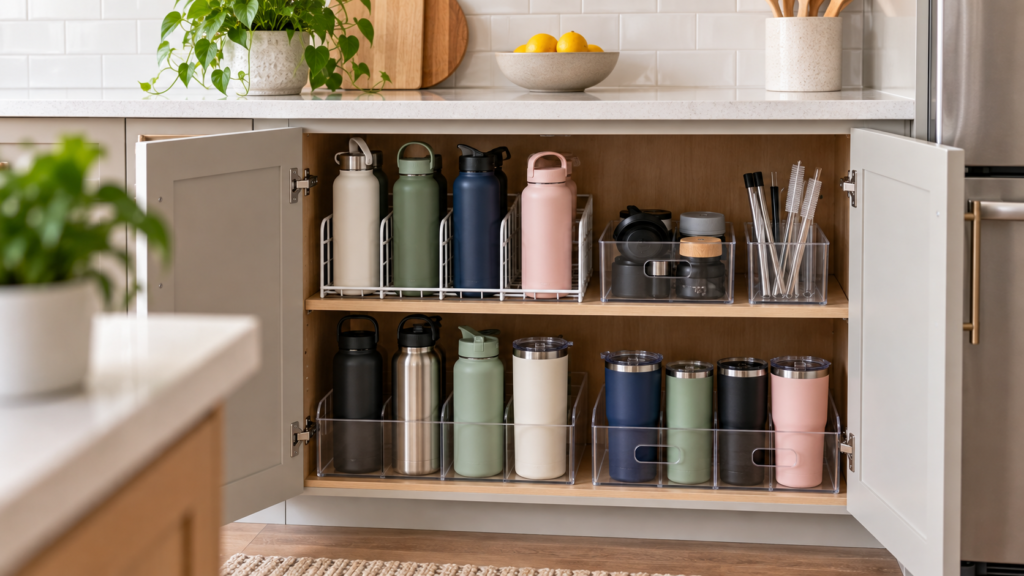
Kitchen water bottle storage ideas can solve a surprisingly frustrating cabinet problem. Reusable bottles, insulated tumblers, travel cups, and their lids come in different heights and widths, making them difficult to stack neatly with ordinary drinkware.
Without a defined system, bottles often fall over, lids disappear behind other items, and cabinets become crowded with containers nobody regularly uses. A better setup gives bottles a predictable home while keeping matching lids and accessories easy to find.
These 12 practical ideas can help you organize your collection using cabinets, drawers, racks, bins, and storage space you may already have.
Table of Contents
- Why Organize Reusable Water Bottles?
- 12 Kitchen Water Bottle Storage Ideas
- How to Choose the Right Storage Method
- How to Set Up Your Water Bottle Storage
- Keeping Bottles Clean Before Storage
- Common Water Bottle Storage Mistakes
- Frequently Asked Questions
- Final Thoughts
Why Organize Reusable Water Bottles?
Reusable bottles are useful, but collections can grow quickly. Different family members may have bottles for work, school, exercise, travel, and everyday use, along with separate lids and straws.
A dedicated storage area makes it easier to see what you own. It also prevents tall bottles from constantly falling over when neighboring items are removed from a cabinet.
Organizing the collection can reveal duplicates and bottles that are rarely used, allowing you to reclaim valuable kitchen space before buying additional organizers.
If loose container accessories are causing similar problems elsewhere in your kitchen, our kitchen food storage container lid organization ideas can help you create a more organized cabinet system.
12 Kitchen Water Bottle Storage Ideas
1. Use a Horizontal Bottle Rack
A rack designed to hold bottles horizontally can create individual spaces for reusable bottles and prevent them from falling across a cabinet shelf.
This method works especially well when the bottles fit securely in the rack. Measure both the bottle diameter and available cabinet depth before choosing an organizer.
2. Store Bottles Upright in a Deep Drawer
A sufficiently deep kitchen drawer can keep bottles upright and visible from above. This eliminates the need to reach behind several rows of bottles inside a cabinet.
Measure the tallest bottles before using this method and make sure they do not interfere with the drawer closing properly.
3. Use Clear Bins Inside a Cabinet
A simple bin can group reusable bottles together and prevent them from spreading into neighboring cabinet categories.
Choose a container that can be pulled forward easily. Avoid packing bottles so tightly that removing one requires emptying the entire bin.
4. Create a Dedicated Bottle Cabinet
If your household uses many reusable bottles, dedicate part of one cabinet to the collection. Keeping bottles separate from glasses, mugs, and food containers can make the area much easier to maintain.
Use the most accessible shelf for everyday bottles and reserve secondary space for specialty or seasonal options.
5. Store Bottles and Lids Separately
Trying to keep every bottle permanently assembled can consume more vertical space. Depending on the bottle design and manufacturer guidance, storing clean, dry lids in a nearby container may make the cabinet easier to organize.
Keep the lid container directly beside the bottles so matching pieces do not migrate to another part of the kitchen.
6. Use a Small Bin for Straws and Accessories
Reusable straws, cleaning brushes, replacement seals, and other small accessories can disappear inside large cabinets. Give these pieces their own small container.
Keeping accessories close to the bottles creates one complete hydration-storage zone rather than spreading related items across several drawers.
7. Organize Bottles by Family Member
In a busy household, assigning a cabinet section or bin to each person can simplify mornings. Everyone knows where their bottles belong and where to return them after cleaning.
This system is particularly useful when family members use similar-looking bottles in different sizes.
8. Organize Bottles by Frequency of Use
Place everyday bottles at the front of a cabinet or in the easiest drawer positions. Bottles used only for hiking, travel, or occasional activities can stay farther back.
Storage should reflect your real routine rather than treating every item as equally important.
9. Use Shelf Risers Carefully
A shelf riser can sometimes create an additional storage level inside a tall cabinet. Shorter bottles may fit underneath while other drinkware occupies the upper level.
Check that the riser is stable and appropriate for the weight of the items you intend to store.
10. Create a Grab-and-Go Hydration Zone
If bottles are filled before work, school, or exercise, store them near the area where that routine happens. A cabinet close to the refrigerator or kitchen exit may be more practical than an organizer on the opposite side of the room.
Convenient placement reduces the chance that clean bottles will end up scattered across countertops.
11. Keep Backup Bottles Separate
Not every reusable bottle needs prime kitchen space. Keep a few everyday bottles accessible and move rarely used backups to a secondary storage location if necessary.
This prevents a large collection from overwhelming the cabinet while still keeping useful extras available.
12. Declutter Before Buying an Organizer
Take every bottle out before purchasing new storage. Check whether each one still has its matching lid, whether it remains in usable condition, and whether anyone actually uses it.
Removing unwanted bottles may solve the storage problem without requiring another organizer at all.
How to Choose the Right Storage Method
Start by measuring the bottles you intend to keep. Pay particular attention to the tallest and widest items because they determine which drawers, racks, and shelves will work.
Next, count the collection after decluttering. Storage designed for eight regularly used bottles will usually work better than buying a large organizer for twenty bottles when half are never used.
Consider whether you prefer bottles upright or horizontal. Deep drawers and tall cabinets often favor upright storage, while divided racks can make horizontal cabinet storage practical.
Finally, choose a location close to your normal routine. A simple storage method in the right location is usually more effective than a sophisticated organizer in an inconvenient cabinet.
How to Set Up Your Water Bottle Storage
Remove bottles, lids, straws, and accessories from their current locations. Match each bottle with its compatible components and identify pieces that are missing or no longer useful.
Clean the cabinet or drawer before returning anything. Then group the remaining collection by frequency of use, family member, or bottle type.
Place everyday bottles in the easiest positions to reach. Give lids and small accessories their own nearby container if that makes the system easier to maintain.
Test the setup for several days. If bottles repeatedly end up on the countertop instead of being returned, reconsider whether the storage location is convenient enough.
Keeping Bottles Clean Before Storage
Reusable water bottles should be cleaned according to the manufacturer’s instructions and allowed to dry appropriately before being stored. Bottle lids, straws, seals, and other components may require separate cleaning because moisture and residue can remain in small spaces.
Do not assume every bottle is dishwasher-safe. Materials, coatings, seals, and insulated designs vary, so follow the instructions provided for the specific product.
For general food-contact cleaning principles, the Centers for Disease Control and Prevention provides household cleaning guidance. Product-specific manufacturer instructions should still guide how individual reusable bottles and components are washed.
Make sure components are sufficiently dry before placing them into enclosed storage. A drying rack can be useful before bottles return to their cabinet or drawer.
Common Water Bottle Storage Mistakes
One common mistake is trying to organize too many bottles. If the collection significantly exceeds what the household uses, even a good organizer can become overcrowded.
Another mistake is placing loose lids throughout the cabinet. Keeping them in one defined container can make matching bottles much faster.
Avoid choosing an organizer before measuring your largest bottles. Oversized insulated tumblers and wide bottles may not fit standard bottle racks.
Finally, avoid putting bottles into enclosed storage before they have been appropriately cleaned and dried.
Frequently Asked Questions
What is the best way to store reusable water bottles?
Deep drawers, dedicated cabinet shelves, bins, and horizontal bottle racks can all work well. The best choice depends on the size of your bottles and your available kitchen storage.
How do I stop water bottles from falling over in a cabinet?
Use a divided rack, appropriately sized bin, or other organizer that gives bottles defined positions. Reducing an overcrowded collection can also improve stability.
Should water bottles be stored with their lids on?
Follow the manufacturer’s care and storage guidance for your specific bottle. Whatever method you use, ensure the bottle and its components have been appropriately cleaned and dried before enclosed storage.
Where should I store water bottle lids?
A small bin or drawer organizer beside the bottle collection keeps lids contained and easy to match. Avoid spreading them across several unrelated kitchen drawers.
How can I organize water bottles in a small kitchen?
Declutter first, keep only frequently used bottles in prime kitchen storage, and consider deep drawers, compact bins, or appropriately sized horizontal racks.
How many reusable water bottles should I keep?
There is no universal number. Keep enough to support your household’s normal routine and activities without allowing rarely used duplicates to consume unnecessary cabinet space.
Final Thoughts
The best kitchen water bottle storage ideas make bottles easy to see, easy to grab, and simple to return after cleaning. A useful system does not need to be complicated.
Start by reducing the collection to bottles your household actually uses. Then choose a cabinet, drawer, rack, or bin that fits those bottles rather than forcing the collection into an unsuitable organizer.
With dedicated space for bottles, lids, and small accessories, you can create a practical hydration zone while reclaiming valuable kitchen storage.