Kitchen food storage container lid organization ideas can solve one of the most frustrating problems inside a busy kitchen cabinet. Containers are usually easy to stack, but their lids come in different shapes and sizes, slide into one another, and often seem to disappear exactly when you need them.
A useful system does not require a perfectly matched collection or an expensive organizer. The goal is to make each lid easy to see, easy to match with its container, and simple to return after dishes are washed and dried.
Table of Contents
Why Organize Food Storage Container Lids?
Loose lids can consume more cabinet space than the containers themselves. When they are stacked randomly, finding the correct size often means pulling out several pieces and testing them one by one.
Separating containers from lids can make stacking more efficient, but the lids then need their own clearly defined storage zone. An organized setup reduces searching and makes it easier to notice missing lids, duplicate pieces, and containers that no longer have a usable match.
If other small kitchen tools are competing for the same drawer and cabinet space, these kitchen measuring cup and spoon storage ideas can help you organize another common group of awkwardly shaped essentials.
12 Kitchen Food Storage Container Lid Organization Ideas
1. Store Lids Vertically in a Divided Bin
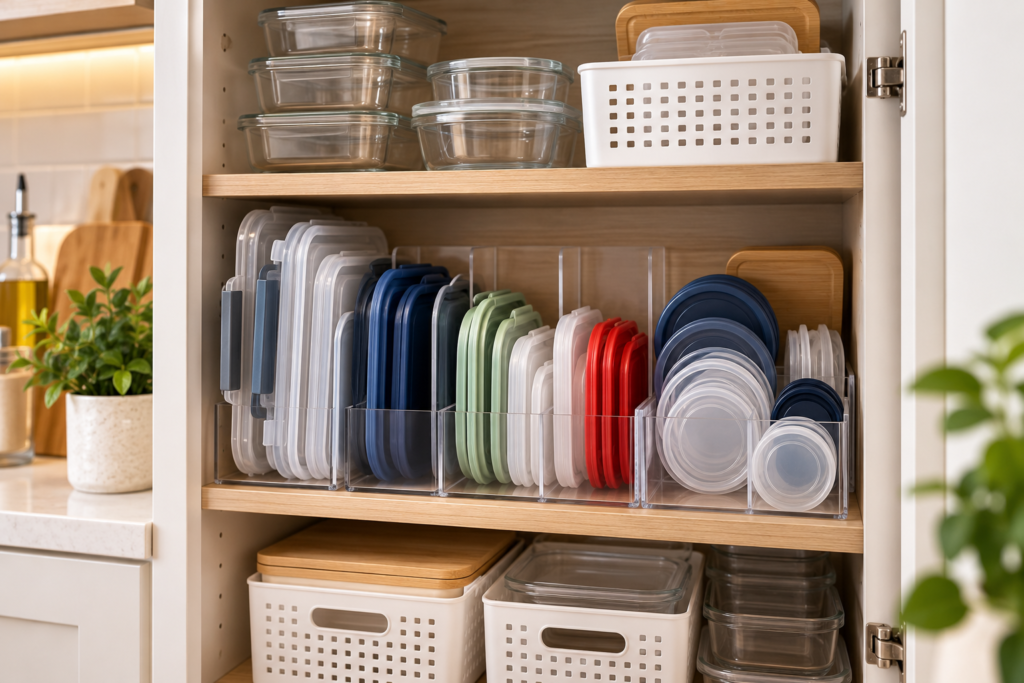
Vertical storage is one of the simplest kitchen food storage container lid organization ideas because it keeps individual lids visible instead of hiding them underneath a stack. Place a divided bin inside a cabinet or deep drawer and arrange lids upright.
Group similar sizes together so small lids do not disappear behind larger ones. Avoid packing the sections too tightly; you should be able to remove one lid without pulling several others with it.
2. Use an Adjustable Lid Organizer
An adjustable organizer can accommodate a collection containing several lid widths. Movable dividers allow you to create narrow sections for small lids and wider sections for larger pieces.
Measure the cabinet or drawer before choosing an organizer. Also measure your tallest and widest lids so the finished setup fits the collection rather than simply fitting the shelf.
3. Create a Dedicated Lid Drawer
If you have a shallow drawer available, it can become an excellent lid station. Arrange lids vertically or in short grouped stacks depending on the drawer depth.
Use dividers to prevent them from sliding every time the drawer opens. Keeping all lids in one location also makes unloading the dishwasher more straightforward because there is only one place to return them.
4. Sort Lids by Size
Organizing by size is useful when you own several containers from the same product family. Create small, medium, and large sections instead of trying to remember which individual lid belongs to every container.
For collections with many similar pieces, sorting by shape first and then by size can make matching even faster.
5. Separate Round and Rectangular Lids
Round lids often stack differently from square or rectangular ones. Giving each shape its own section prevents smaller pieces from becoming trapped between larger lids.
This simple separation can be especially effective if your food storage collection includes containers from several brands or sets.
6. Use a Low Bin on a Cabinet Shelf
A low open bin can contain lids without making them difficult to reach. Choose one that can be pulled forward easily, particularly if the cabinet shelf is deep.
A bin with straight sides usually makes better use of space than an excessively tapered container. Keep the contents limited to food storage lids rather than allowing unrelated kitchen items to accumulate inside.
7. Add Dividers to a Deep Drawer
A deep drawer can hold containers and lids together while still keeping them separated. Stack containers in one section and position lids vertically in another using sturdy dividers.
This creates a complete food storage station in one place. It can also reduce the need to move between different cabinets when packing leftovers or preparing lunches.
8. Store Frequently Used Lids at the Front
Not every container gets used equally. Keep lids for your everyday lunch boxes and leftover containers toward the front of the organizer while specialty or occasional sizes can stay farther back.
Organizing around frequency of use makes the system more convenient without requiring additional storage products.
9. Use a Pull-Out Cabinet Bin
Deep lower cabinets can make small items difficult to reach. A pull-out bin allows the entire lid collection to move forward so pieces at the back remain visible.
Check cabinet hinges, plumbing, and shelf clearance before choosing a pull-out solution. The organizer should move smoothly without striking the cabinet door.
10. Keep Matching Container Sets Together by Zone
If you own several distinct container sets, assign each set its own section. This is useful when lids look similar but are not interchangeable.
You do not necessarily need labels. Physical separation alone may be enough to prevent almost-identical lids from becoming mixed together.
11. Use Simple Labels for a Large Collection
Labels can help when several people put dishes away or when the household owns many container sizes. Simple labels such as small, medium, large, round, and rectangular are usually enough.
Avoid creating an overly detailed labeling system that takes more effort to maintain than the clutter it is supposed to solve.
12. Reduce the Collection Before Organizing It
Sometimes the best organizer is simply fewer pieces. Match every lid with a compatible container before deciding how much storage space the collection needs.
Set aside damaged containers, cracked lids, and unmatched pieces. Follow local guidance and manufacturer information when deciding whether an unwanted plastic item can be recycled in your area.
How to Set Up Your Lid Storage System
Begin by taking every food storage container and lid out of the cabinet or drawer. Match the pieces before buying any organizers. This immediately reveals how many complete sets you actually own.
Next, group the remaining lids by shape and approximate size. Measure the largest pieces as well as the drawer, shelf, or cabinet where you intend to store them.
Choose a system that allows frequently used lids to remain visible. Vertical storage is often practical, but shallow drawers may work better with carefully arranged stacks.
Finally, test the setup during normal kitchen use. If everyone can find and return a lid without reorganizing the cabinet, the system is doing its job.
How to Keep the System Organized
The easiest organization system is one that requires very little effort after dishes are washed. Give lids one clearly defined location and avoid creating several different storage spots around the kitchen.
Return clean, dry lids to their correct section rather than dropping them into the nearest cabinet. If a container breaks or is discarded, check whether its lid is still sitting in the organizer.
Every few months, quickly match the collection again. This prevents orphaned lids from gradually taking over valuable cabinet space.
Common Container Lid Storage Mistakes
A common mistake is stacking every lid horizontally in one tall pile. It may look neat immediately after organizing, but retrieving a lid from the bottom can disturb the entire stack.
Another mistake is buying an organizer before checking the collection. Container lids vary widely in height and width, so a product that works for one kitchen may waste space in another.
Avoid keeping damaged food storage items simply because they belong to a set. Follow the manufacturer’s instructions regarding appropriate use and replacement of individual products.
For general information about the safe use of food-contact materials, the U.S. Food and Drug Administration provides information about food-contact substances. For your specific containers, always follow the manufacturer’s instructions regarding use, heating, cleaning, and storage.
Frequently Asked Questions
What is the best way to organize food storage container lids?
For many kitchens, storing lids vertically in a divided bin, adjustable organizer, or deep drawer makes them easy to see and retrieve. The best method depends on the dimensions of your collection and available cabinet space.
Should containers and lids be stored separately?
They can be. Separating lids often allows empty containers to nest more efficiently. However, households with a small collection may prefer keeping complete sets together. Choose the method that makes items easiest to find and return.
How do I organize lots of different lid sizes?
Separate them first by shape and then by approximate size. Adjustable dividers or several sections within one bin can prevent small lids from becoming hidden behind larger pieces.
How can I organize container lids in a small kitchen?
Use a compact vertical organizer inside an existing drawer or cabinet rather than dedicating additional countertop space. Decluttering unmatched or unnecessary pieces can also significantly reduce the amount of storage required.
How do I stop lids from falling over in a drawer?
Use drawer dividers or an organizer with narrow sections. Avoid making each section excessively wide because lids are more likely to collapse into a pile when they have too much unsupported space.
What should I do with lids that have no matching container?
Confirm that the matching container is genuinely gone before removing the lid. If it is no longer useful, check the product material and your local recycling requirements or disposal guidance rather than assuming every plastic lid is accepted for recycling.
Final Thoughts
The most effective kitchen food storage container lid organization ideas make matching and returning lids almost automatic. Vertical dividers, dedicated drawers, pull-out bins, and simple size-based zones can all work well when they fit the collection you already own.
Start by matching and decluttering your containers, then measure the available space before choosing an organizer. A simple system with fewer complete sets is often easier to maintain than a crowded cabinet filled with unmatched lids.