Reusable food containers are useful until unmatched lids, warped boxes, and unstable stacks take over a cabinet. A crowded collection slows down meal cleanup and makes it difficult to find a container that fits the food you need to store.
These kitchen food container storage ideas create order without requiring an oversized pantry. The goal is to keep safe, complete pieces visible, pair lids quickly, and use drawers or cabinets according to their actual dimensions.
Table of Contents
1. Kitchen Food Container Storage Ideas: Match Every Lid First
Empty the entire storage area and match each container with its correct lid. Test the fit rather than relying on color alone. Set aside cracked containers, lids that no longer seal, and any single pieces that have no usable partner.
Check the material and manufacturer guidance before recycling or discarding items. Once incomplete pieces are removed, count the containers that remain. This gives you an accurate collection to organize and prevents purchasing a solution that is larger than necessary.
2. Keep Only the Sizes You Regularly Use
A useful collection usually contains a small range of sizes for sauces, individual portions, family leftovers, and meal preparation. Multiple novelty shapes often waste space because they do not nest or share lids.
Keep enough containers for your normal cooking pattern, not every possible occasion. If you host occasionally, a separate small set can live on a higher shelf. Reducing duplicate or awkward pieces makes every later organizing step more effective.
3. Nest Containers by Shape
Place smaller containers inside larger ones, grouping squares with squares and rounds with rounds. Keep the stack shallow enough that the container you need can be removed without lifting a heavy tower.
Do not force containers together, particularly when they are slightly damp. A trapped piece can crack or distort. Leave the top container uncovered so air can circulate after washing, and confirm that every item is completely dry before closing the cabinet.
4. Store Lids Vertically in a Divider
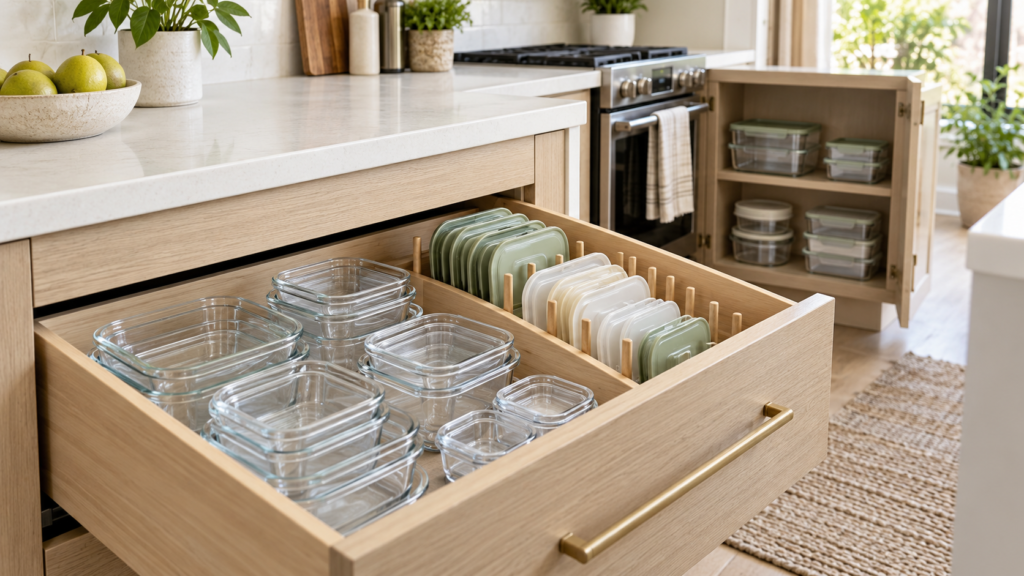
A vertical divider turns lids into a visible file rather than a slippery horizontal pile. Use a plate rack, adjustable drawer divider, or narrow bin and arrange lids by shape first, then by size.
Keep the divider close to the containers so pairing remains intuitive. It should be tall enough to support lids but not so tight that edges bend. Place very small lids in a separate shallow section where they cannot slide underneath larger ones.
5. Use a Deep Drawer When Available
A deep lower drawer offers a clear view from above and eliminates reaching into the back of a dark cabinet. Use one section for nested containers and another for upright lids.
Measure the internal height with the drawer closed, including any plumbing or counter supports above it. Test the layout before adding permanent dividers. Heavier glass containers should stay in the lowest drawer and should not be stacked beyond a stable, easy-to-lift height.
6. Add Pull-Out Access to a Base Cabinet
If containers must stay in a lower cabinet, a pull-out tray brings the entire collection forward. This reduces forgotten pieces at the back and makes it easier to maintain separate zones for boxes and lids.
Choose hardware rated for the combined load, especially if you use glass. Leave clearance for hinges and door frames, and follow the manufacturer’s installation instructions. For a broader cabinet reset, explore our kitchen cabinet organization ideas.
7. Use a Simple Bin for Lightweight Lids
A narrow handled bin is an inexpensive option for plastic lids. Stand lids upright with the smallest at the front and the largest at the back so their edges remain visible.
Avoid mixing unrelated items in the same bin. Measuring cups, water-bottle parts, and lunch accessories create a new jumble. Give those categories separate homes and reserve this bin for lids that belong to the nearby container stack.
8. Separate Glass and Plastic Containers
Glass containers are heavier and often do not nest as deeply as plastic. Store them on a low shelf or in a deep drawer where lifting is controlled, while lightweight plastic can occupy a higher cabinet.
Use shelf liner if glass slides on a smooth surface, and check for chips before each use. Separating materials also makes it easier to choose the right container for reheating, freezing, or transporting food according to its care instructions.
9. Create a Lunch-Packing Zone
Keep the containers used for work or school lunches together with their matching lids. A compact zone might include two portion sizes, small condiment cups, and reusable snack boxes.
Locate this group near lunch bags or the usual food-preparation area. Limiting the zone to items that leave the house prevents the main storage area from being disturbed every morning and makes missing pieces noticeable sooner.
10. Avoid Stacking Containers With Lids Attached
Storing every container with its lid attached may feel orderly, but it consumes far more cabinet space and can trap moisture after washing. Nesting open containers and filing dry lids separately is usually more efficient.
An exception may be one or two frequently used containers that are difficult to match. If you store those closed, make certain both parts are completely dry and leave them in a well-ventilated cabinet rather than a damp area beside the sink.
11. Label Similar Sets Without Creating Visual Noise
When two container ranges look alike but do not share lids, add a small removable color dot to the underside of each matching piece. The mark speeds up pairing without covering the cabinet in large labels.
Use the lightest system that solves the problem. If shape and size already make the match obvious, skip labels entirely. Clear categories and limited quantities are easier to maintain than detailed rules that household members will ignore.
12. Reset the Collection Every Three Months
During a quarterly check, match lids again, remove damaged pieces, and return containers that have migrated to lunch bags or other rooms. Wipe the shelf or drawer before rebuilding the layout.
The U.S. Food and Drug Administration advises using containers intended for food and following product directions. Its food storage guidance also explains safe refrigeration practices; organization should support, not replace, safe handling.
Should Food Containers Be Stored With Lids On or Off?
For most collections, storing clean containers open and nested while keeping lids upright nearby saves the most space. It also lets you see whether the pieces are fully dry before they go into the cabinet.
Store a lid on its container only when the pair is uniquely shaped, used constantly, or difficult to identify. Whichever method you choose, do not seal residual moisture inside and do not keep damaged containers in active rotation.
Final Thoughts
Practical kitchen food container storage ideas begin with a matched, safe collection. Once excess pieces are removed, shape-based nesting, vertical lid storage, and a defined lunch zone make daily use faster.
Choose an arrangement that fits your real drawer or cabinet rather than copying a system designed for a larger kitchen. A quick quarterly reset will keep the collection complete, dry, and ready for leftovers.