Kitchen drawers work best when every item has a clear home close to where it is used. Instead of filling drawers with random organizers, begin by deciding which tools deserve the most accessible positions. These kitchen drawer organization ideas will help you reduce clutter, protect sharp utensils, and make cooking and cleanup more efficient.
You do not need to reorganize the entire kitchen at once. Start with one problem drawer, measure it carefully, and create a layout based on your actual cooking habits. A simple system that is easy to maintain will usually work better than an elaborate arrangement with too many compartments.
Table of Contents
- Sort Everything Before You Organize
- Create Zones for Everyday Tasks
- Use Adjustable Drawer Dividers
- Keep Cooking Utensils Near the Stove
- Store Knives Safely
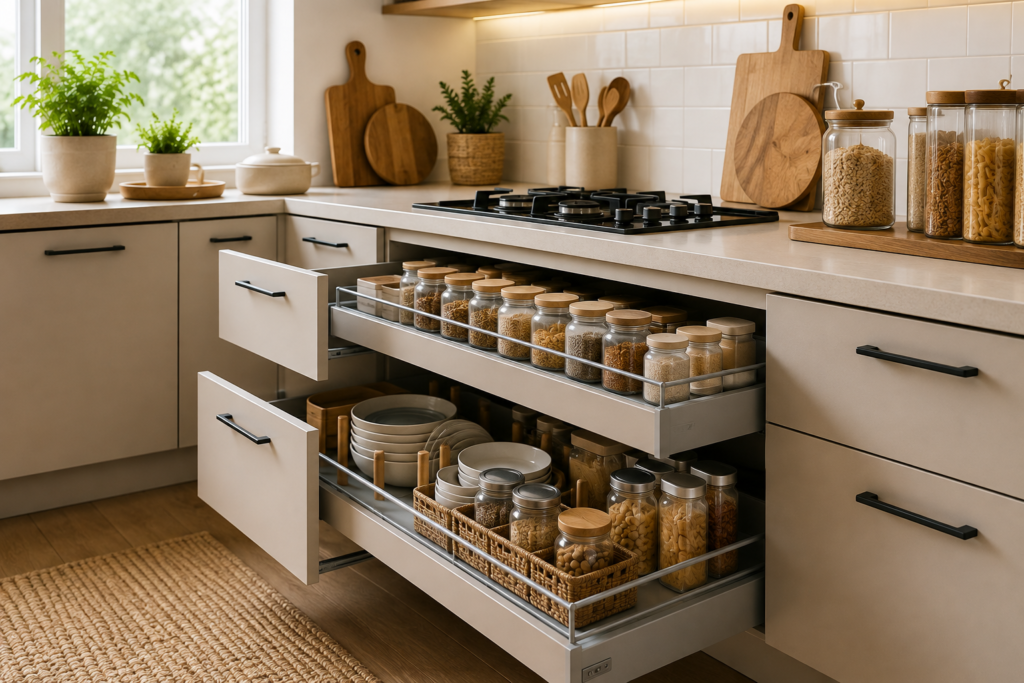
- Organize Spices in a Drawer
- Use Shallow Trays for Small Tools
- Stand Food Storage Lids Upright
- Separate Baking Tools
- Control the Junk Drawer
- Label Hidden Compartments
- Review Drawers Every Season
- What to Measure Before Buying Organizers
- Kitchen Drawer Organization Ideas: Mistakes to Avoid
- Frequently Asked Questions
Sort Everything Before You Organize
Empty one drawer completely and place its contents on a counter or table. Group similar items together, such as cooking utensils, measuring tools, food-storage accessories, and miscellaneous objects. Remove duplicates, damaged tools, expired coupons, and anything that belongs elsewhere. This step reveals what the drawer genuinely needs to hold and prevents you from buying organizers for items you should discard or relocate.
Before returning anything, wipe the drawer and check that the runners, corners, and base are in good condition. Keep the tools you use weekly in the most accessible drawers. Specialty gadgets used only a few times a year can move to a higher cabinet or clearly labeled container.
Create Zones for Everyday Tasks
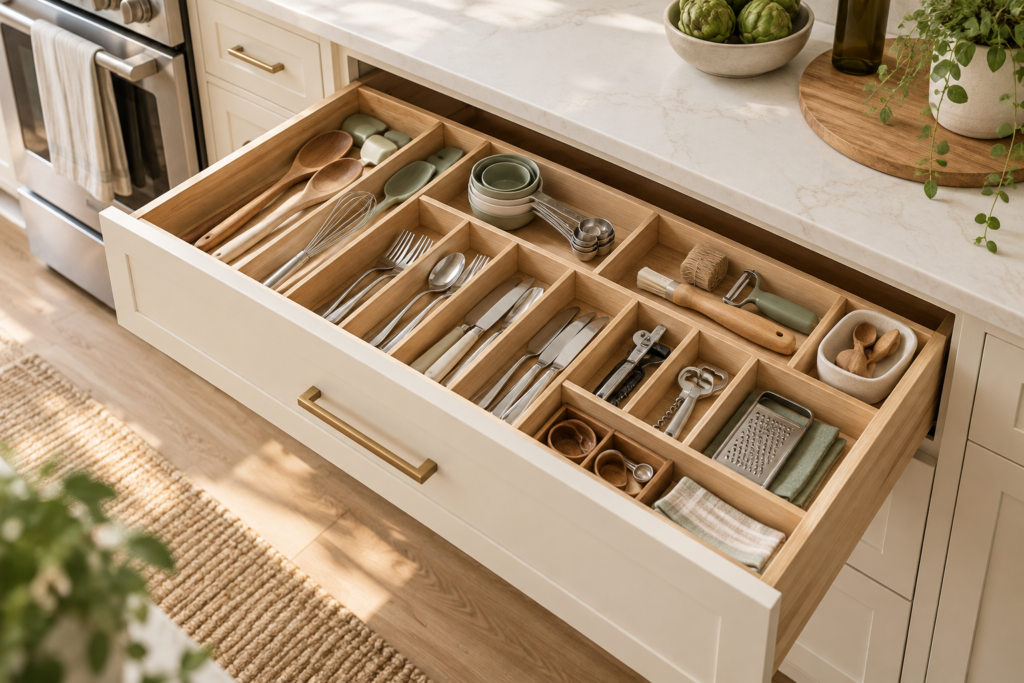
Organize drawers according to kitchen activities rather than placing items wherever space is available. A preparation zone might contain peelers, graters, measuring spoons, and kitchen scissors. A cooking zone near the stove can hold spatulas, tongs, and wooden spoons, while a serving zone can contain cutlery, trivets, and serving utensils.
Task-based zones reduce unnecessary movement while you cook and make it easier for everyone to return tools correctly. Avoid mixing unrelated categories in the same compartment. If a drawer must serve two purposes, give each category a clearly separated side.
Use Adjustable Drawer Dividers
Adjustable dividers are useful for long utensils and drawers whose dimensions do not suit standard trays. Position the dividers around the items you own instead of forcing tools into compartments that are too short or narrow. Bamboo dividers provide a warm appearance, while washable plastic versions are practical near food-preparation areas.
Leave a small amount of open space in each section so items can be removed without catching on one another. Check the internal width, depth, and height of the drawer before purchasing dividers, including any space occupied by handles or drawer hardware.
Keep Cooking Utensils Near the Stove
Place the utensils used during cooking in the drawer closest to the main preparation area or stove. Tongs, spatulas, wooden spoons, and turners should be reachable without crossing the kitchen while carrying a hot pan. Arrange them by function or frequency of use, with everyday tools at the front.
Do not overcrowd this drawer with every utensil you own. Keep one or two reliable versions of each frequently used tool and relocate duplicates. If long handles prevent the drawer from closing smoothly, use diagonal dividers or move the tallest pieces to a countertop utensil holder.
Store Knives Safely
Loose knives can damage their edges and create a serious risk when someone reaches into the drawer. Use an in-drawer knife block, fitted blade guards, or a purpose-built knife tray that keeps every blade covered and separated. Position knife handles in the same direction so they are easy to identify and lift safely.
Choose a location that children cannot access, and never place knives beneath other utensils. The organizer should fit firmly enough that it does not slide when the drawer opens. Keep kitchen scissors in their own compartment rather than resting them on top of knife handles.
Organize Spices in a Drawer
A shallow drawer can keep spice labels visible and prevent small jars from disappearing behind larger containers. Use an angled insert or arrange jars horizontally in neat rows with the labels facing upward. Alphabetical order works for a large collection, while grouping spices by cooking style may be faster for a smaller household.
Check that the closed drawer leaves enough clearance above every jar. Write the purchase or refill date on containers whose freshness is difficult to track. Keep spices away from excessive heat and moisture; a drawer directly beside a hot oven may be convenient but can be unsuitable for long-term storage.
Use Shallow Trays for Small Tools
Small tools such as bottle openers, vegetable peelers, bag clips, measuring spoons, and thermometer probes are easily buried beneath larger utensils. Place them in shallow removable trays so each category remains visible. Modular trays are especially helpful because you can rearrange them when your needs change.
Avoid creating a separate compartment for every individual object. Combine items that are used for the same activity and keep enough room to lift them comfortably. Removable trays also simplify cleaning because crumbs can be emptied without dismantling the entire drawer system.
Stand Food Storage Lids Upright
Stacked food-container lids are difficult to search and often slide around when the drawer opens. Store them vertically in an adjustable rack or deep divider, then arrange them from smallest to largest. Separate round and rectangular lids if your collection contains several container styles.
Match every lid with a container before organizing and recycle damaged, warped, or unmatched pieces where local facilities permit. Nest empty containers by shape in a nearby drawer or cabinet. Limiting the collection to a few compatible sizes makes pairing, stacking, and replacing containers much easier.
Separate Baking Tools
Keep measuring cups, measuring spoons, piping tips, pastry brushes, cookie cutters, and other baking tools together. A dedicated drawer near the main work surface prevents small baking accessories from becoming mixed with everyday cooking utensils. Nest measuring cups and clip each measuring-spoon set together so individual pieces do not disappear.
Use small lidded boxes for delicate or seasonal items such as piping nozzles and decorative cutters. If you bake infrequently, place the entire category in a labeled bin inside a cabinet rather than occupying a prime drawer needed for daily cooking.
Control the Junk Drawer
A utility drawer can be useful, but it needs defined limits. Use small compartments for pens, tape, batteries, a measuring tape, and other household essentials. Remove receipts, unidentified keys, dried markers, and objects that have a better permanent location. Avoid storing medication, loose sharp objects, or important documents in an unstructured drawer.
Give the drawer a simple rule: every item must fit within an assigned compartment. When a section becomes full, remove something before adding more. A five-minute monthly check is usually enough to prevent the drawer from returning to its previous condition.
Label Hidden Compartments
Labels are helpful when several family members use the kitchen or when drawer contents are not immediately visible. Add small removable labels inside deep drawers for categories such as baking, lunch supplies, wraps, and spare utensils. Labels should guide the system without making it too rigid.
Use broad category names that can accommodate small changes. A label reading “food storage” is more flexible than one listing every type of bag and wrap. Place labels where they remain readable when the drawer is open, and replace them whenever the contents change.
Review Drawers Every Season
Kitchen needs change as tools are replaced and cooking habits evolve. Every three or four months, check for duplicates, damaged utensils, loose crumbs, and items that have migrated into the wrong drawer. Wash removable organizers and wipe the drawer interiors before returning everything. For food-contact tools, follow FoodSafety.gov’s guidance to wash utensils and surfaces after each use.
Notice which tools remain unused during several reviews. Unless they serve an important seasonal purpose, consider donating or relocating them. Regular maintenance is faster than repeatedly completing a full kitchen reorganization and helps preserve space for items you genuinely use.
What to Measure Before Buying Organizers
Measure the usable internal width, front-to-back depth, and height of each drawer—not the outside cabinet dimensions. Check whether the drawer narrows around its runners or hardware. For stacked trays, confirm that the upper layer will clear both the items below and the cabinet frame when the drawer closes.
- Record measurements in inches and centimetres.
- Measure at the front, middle, and back of older drawers.
- Allow space for trays to lift out during cleaning.
- Check the length of your longest utensils.
- Test the proposed arrangement with cardboard before purchasing.
For storage beyond the drawers, explore these kitchen cabinet organization ideas and coordinate both areas around the same everyday tasks.
Kitchen Drawer Organization Ideas: Mistakes to Avoid
The most common mistake is buying organizers before sorting and measuring. Another is filling every centimetre of space, which makes items difficult to remove and leaves no room for future needs. Deep containers can also hide small tools, while too many tiny compartments create a system that is frustrating to maintain.
Avoid placing heavy appliances or unstable stacks in lightweight drawers. Do not store sharp tools loosely, and keep heat-sensitive items away from ovens. Finally, organize according to your real routine rather than a staged photograph. The best layout is the one that remains functional after several weeks of normal use.
Frequently Asked Questions
How do I organize a kitchen with very few drawers?
Reserve drawers for small items that are difficult to store safely elsewhere. Move long utensils to a countertop holder, hang suitable tools on a rail, and use cabinet shelves for larger categories. Prioritize cutlery, sharp tools, and frequently used preparation accessories.
What is the best material for drawer organizers?
Washable plastic is practical for areas exposed to crumbs or spills. Bamboo provides a warmer appearance but should be kept dry. Metal dividers can be durable for heavier tools. The best choice depends on the drawer location, contents, cleaning needs, and available dimensions.
How can I stop organizers from sliding?
Use a washable nonslip liner beneath the trays or add removable silicone feet to their corners. A modular arrangement that fits the drawer closely will also move less. Avoid permanent adhesive until you have tested the layout and confirmed that it works.
How often should kitchen drawers be reorganized?
Perform a quick check monthly and a more thorough review every three or four months. Clean spills immediately, return misplaced objects during the monthly check, and use the seasonal review to remove duplicates or adjust categories.
Final Thoughts
Effective kitchen drawer organization begins with editing what you own, measuring carefully, and placing tools near the tasks they support. Adjustable dividers, shallow trays, safe knife storage, and clear categories can improve daily routines without requiring a major renovation.
Start with the drawer that causes the most frustration and test the new arrangement before buying additional products. Once the drawers are working well, use these kitchen pantry shelving ideas to create a more consistent storage system throughout the room.