Bedroom belt storage ideas can turn a small but frustrating closet problem into an organized part of your daily routine. Belts are easy to drape over chairs, bury inside drawers, or pile onto closet shelves, where buckles become tangled and the belt you want is difficult to find.
A practical storage system keeps each belt visible, accessible, and easy to return after use. Whether you have a spacious walk-in closet or one small wardrobe, you can organize belts without sacrificing valuable clothing space.
Table of Contents
- Why Organize Your Belts?
- 12 Smart Bedroom Belt Storage Ideas
- How to Choose the Right Belt Storage Method
- How to Set Up an Organized Belt Collection
- How to Store Belts More Carefully
- Common Belt Storage Mistakes
- Frequently Asked Questions
- Final Thoughts
Why Organize Your Belts?
Belts occupy relatively little space individually, but an unorganized collection can quickly become difficult to manage. Long straps overlap, buckles catch on neighboring accessories, and frequently used belts disappear underneath pieces you rarely wear.
Giving belts a dedicated location makes it easier to see your options while getting dressed. It can also prevent them from spreading into drawers and shelves intended for other bedroom essentials.
A good system should suit both the number of belts you own and the way you naturally use them. Someone with four everyday belts needs a different solution from someone maintaining a larger collection of dress, casual, and seasonal styles.
If other accessories are also competing for closet space, these bedroom scarf storage ideas can help you organize another collection of frequently tangled accessories.
12 Smart Bedroom Belt Storage Ideas
1. Use a Dedicated Belt Hanger
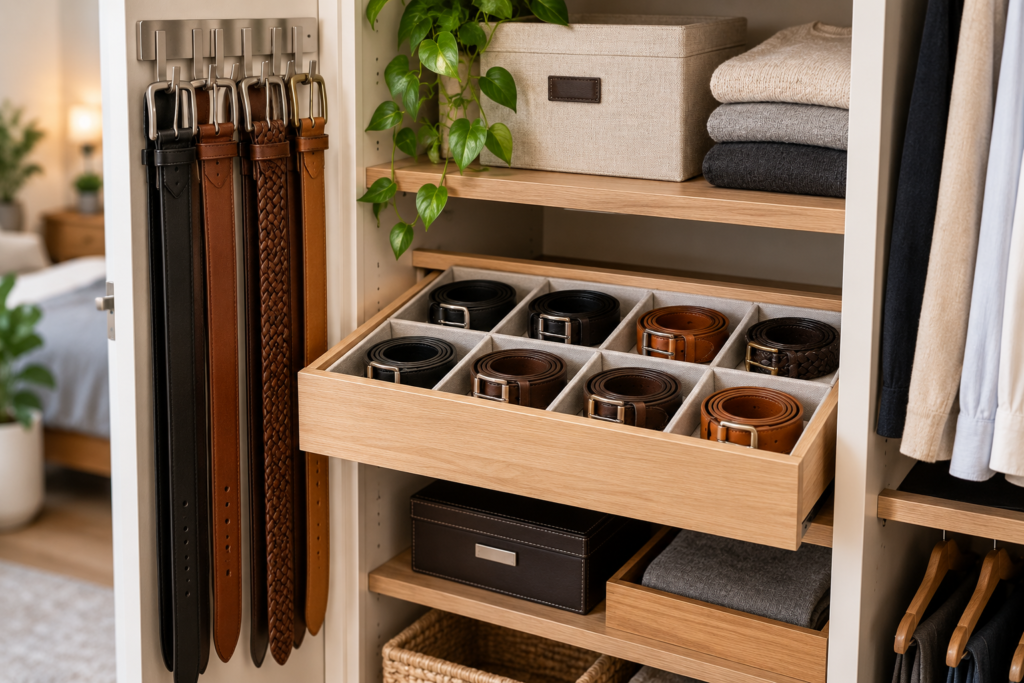
A purpose-made belt hanger is one of the easiest bedroom belt storage ideas for a closet with available hanging space. Multiple hooks allow several belts to occupy roughly the same area as one regular clothes hanger.
Position frequently used belts toward the easiest-to-reach hooks. Avoid overcrowding each hook because separating several overlapping belts can make the organizer inconvenient.
2. Add Hooks to an Empty Closet Wall
An unused section of closet wall can become a compact accessory station. Install individual hooks and hang one or two belts from each, depending on the hook size.
This arrangement keeps belts visible and can make use of narrow vertical space that would otherwise remain empty. Follow the hardware manufacturer’s installation instructions and choose mounting appropriate for the wall surface.
3. Roll Belts Inside a Drawer
Drawer storage works well when hanging space is limited. Loosely roll each belt and arrange the rolls side by side rather than stacking them in a deep pile.
A shallow drawer is especially useful because the entire collection can remain visible from above. The goal is a gentle, practical arrangement rather than forcing belts into extremely tight coils.
4. Use Drawer Dividers
Dividers can prevent rolled belts from moving around whenever a drawer opens. Create compartments according to the size of your collection and leave enough room to remove individual pieces comfortably.
You can also divide the drawer by category—for example, everyday belts in one section and dress belts in another.
5. Use the Inside of the Closet Door
The back of a closet door can provide useful vertical storage in a compact bedroom. A suitable door-mounted organizer or hook system can keep belts accessible without occupying a shelf or drawer.
Before installing anything, check that the organizer will not interfere with shelves, clothing, hinges, or the door closing properly.
6. Create an Everyday Belt Zone
If you regularly rotate between only a few belts, give those pieces the most convenient location. They might occupy the first hooks on a hanger or the front section of a drawer.
Less frequently used pieces can remain farther back. Organizing according to frequency of use reduces unnecessary searching during busy mornings.
7. Separate Casual and Dress Belts
Dividing belts by how you wear them can make outfit selection faster. Casual belts can occupy one section while formal or dressier styles stay together in another.
This system is especially helpful when several belts have similar colors but different widths, buckles, or finishes.
8. Use a Small Accessory Drawer
A dedicated accessory drawer can hold belts alongside carefully separated watches, scarves, or other items. Use compartments so buckles and straps do not become mixed with smaller accessories.
Keeping related items in one location can simplify getting dressed while maintaining clear boundaries between categories.
9. Install a Pull-Out Closet Rack
A pull-out accessory rack can work well in a fitted wardrobe or larger closet. When stored, the belts occupy a narrow vertical area; when needed, the rack pulls forward for easier access.
This is a more permanent solution than a basic hanger, so measure carefully and make sure the hardware is compatible with the closet before installation.
10. Organize Belts by Color
Once your storage method is working, arranging belts by color can make matching them with outfits easier. Group dark neutrals, lighter neutrals, and accent colors in a sequence that makes sense to you.
Color organization is optional. Accessibility and ease of maintenance matter more than creating a perfectly arranged display.
11. Keep Special-Occasion Belts Separate
Belts worn only with certain outfits do not need prime closet space. Store occasional pieces in a secondary section while keeping everyday options immediately accessible.
This prevents rarely used accessories from making your main storage zone unnecessarily crowded.
12. Declutter Before Buying an Organizer
Before purchasing additional storage, take every belt out and review the collection. Set aside pieces that no longer fit, suit your wardrobe, or remain in usable condition.
Once you know how many belts you actually want to keep, it becomes much easier to choose an appropriately sized organizer.
How to Choose the Right Belt Storage Method
Start by counting the belts you regularly use. A small collection may fit comfortably on one multi-hook hanger, while a larger collection may benefit from a drawer, wall hooks, or a dedicated closet accessory system.
Next, look at which type of bedroom storage is most available. If your hanging rail is already crowded, using drawer or door space may be more practical. If drawers are limited, vertical closet storage can preserve valuable folded-clothing space.
Consider visibility as well. If you often forget what accessories you own, an open hanger or hook arrangement may be more useful than a closed box.
Finally, make sure your chosen system is easy to maintain. You should be able to remove and return a belt in seconds without rearranging the rest of the collection.
How to Set Up an Organized Belt Collection
Begin by gathering belts from drawers, closet shelves, chairs, and other areas of the bedroom. Seeing the entire collection together makes duplicates and rarely used pieces easier to identify.
Sort the belts into everyday, occasional, and no-longer-needed groups. Then decide whether hanging or drawer storage better matches your available space.
Place frequently worn belts in the most accessible positions. If you use compartments or hooks, leave a little extra capacity instead of filling every available space immediately.
Once the system is established, return belts to the same location after wearing them. Consistency is more important than creating an elaborate arrangement.
How to Store Belts More Carefully
Different belt materials and constructions can require different care. Follow the manufacturer’s instructions when they are available, particularly for leather or specialty materials.
Avoid storing accessories while they are damp or dirty. Keep the storage area reasonably clean and dry, and avoid unnecessarily crushing belts underneath heavy clothing or boxes.
For leather items, general conservation guidance emphasizes avoiding excessive moisture, heat, and unsuitable storage conditions. The Canadian Conservation Institute provides guidance on the care of leather, skin, and fur objects. For everyday belts, prioritize the care directions supplied by the product manufacturer.
Common Belt Storage Mistakes
One common mistake is throwing every belt into a deep drawer without compartments. Straps and buckles can become intertwined, and the belts at the bottom are easily forgotten.
Another mistake is putting too many belts onto one small hook. Although this technically saves space, retrieving the innermost belt becomes inconvenient and can disturb the entire group.
Avoid buying an oversized organizer before decluttering. Storage should fit the collection you actually use rather than preserving unnecessary accessories.
Finally, do not create a system that requires several steps to put a belt away. Simple storage is generally easier to maintain over time.
Frequently Asked Questions
What is the best way to store belts in a bedroom?
Multi-hook belt hangers, closet hooks, divided drawers, and door-mounted organizers can all work well. The best option depends on the number of belts you own and whether your closet has more available hanging, drawer, or vertical space.
Is it better to hang or roll belts?
Either method can be practical depending on the belt and its care instructions. Hanging provides visibility and uses vertical space, while loose drawer storage can work well when closet rails are crowded. Avoid forcing belts into excessively tight arrangements.
How do I organize belts in a small closet?
Use vertical space with a multi-hook hanger, a suitable door organizer, or a narrow section of wall hooks. Keeping only regularly used belts can further reduce the amount of storage required.
How can I organize belts in a drawer?
Arrange them in separate compartments using drawer dividers. Keeping individual pieces visible from above makes it easier to select a belt without disturbing the rest of the drawer.
Can belts be stored with other accessories?
Yes. A dedicated accessory drawer or closet zone can hold multiple categories as long as belts have their own section and do not become tangled with smaller items.
How often should I declutter my belt collection?
There is no required schedule. Review the collection when the organizer becomes crowded or when you are already reorganizing your wardrobe. Remove pieces that no longer serve your current needs.
Final Thoughts
Effective bedroom belt storage ideas do not need to be complicated. A dedicated hanger, divided drawer, closet hooks, or a small door-mounted system can keep belts visible and accessible while using space efficiently.
Start by reducing the collection to pieces you actually use, choose storage based on your available closet space, and keep everyday belts within easy reach. A straightforward system is far more likely to stay organized long after the initial closet cleanup.