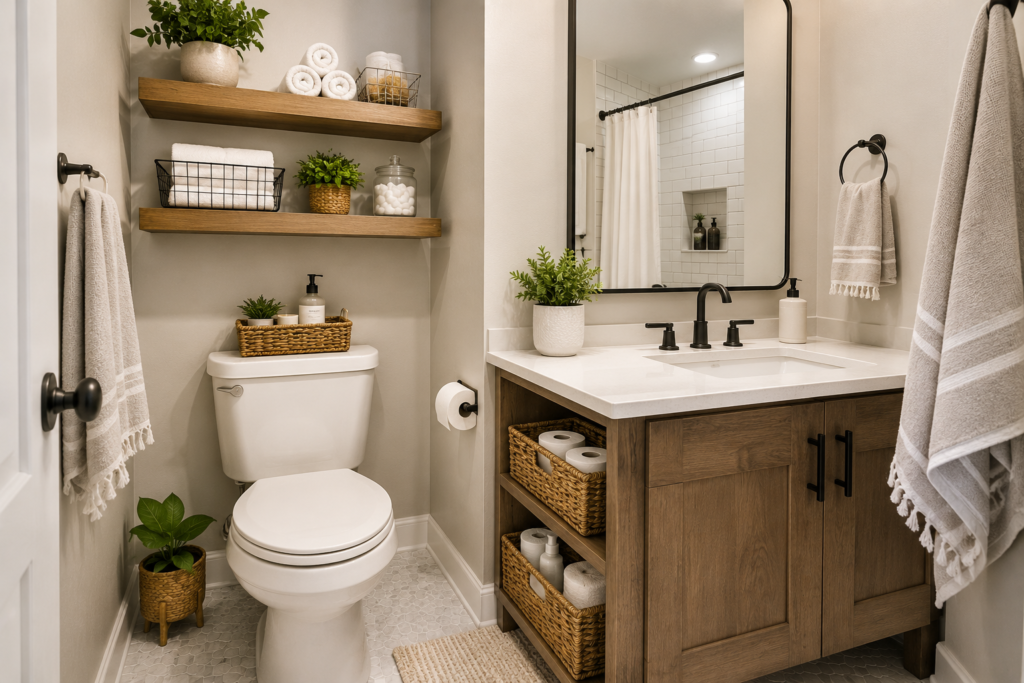
What this guide covers: This guide focuses on towel hooks for towels currently in use: mounting surfaces, reach, door clearance and fabric separation. For folded clean towels, backup linens and laundry rotation, see the complete bathroom towel storage guide.
Bathroom towel hook organization ideas work when reach, hanging fabric and mounting conditions are checked together. Choose the towels that need a place, compare the available wall or door space, and confirm the product instructions before installation.
Table of Contents
- Choose a hanging method and estimate spacing
- Check placement before installation
- 12 Bathroom Towel Hook Organization Ideas
- How to Choose the Right Hook Placement
- Common Towel Hook Mistakes to Avoid
- Frequently Asked Questions
- Check the setup after use
Choose a Hook, Bar or Door Rack for the Constraint
Scroll sideways to read the full table.
| Your constraint | Option and check |
|---|---|
| Narrow wall, one towel in use | Try a single suitable hook if the fabric can hang clear of fixtures and remain accessible. |
| Several large towels bunch together | Compare a wider hanging layout or towel bars. Adding hooks does not add usable separation if fabric still overlaps. |
| No permission to drill | Consider a surface-compatible bathroom adhesive product or a door rack that fits the door. Follow product and tenancy requirements; neither option fits every surface. |
| Door is the only free surface | Check the whole door swing and closure with the rack and towels in place. Reject a setup that strikes a fixture or prevents normal closing. |
| Clean spare towels need storage | Use a separate dry shelf or cabinet. Hooks in this guide are for towels currently in use. |
Estimate spacing from the hanging fabric
Measure how far each towel extends left and right from its proposed hanging point. This changes with towel size, folding and hook shape. Use those spans to compare a layout before making mounting holes.
Illustrative example: the left towel extends 12 cm toward the right; the right towel extends 15 cm toward the left. You choose a 3 cm gap between the fabric edges. Planned distance between hanging points = 12 + 15 + 3 = 30 cm. This is an invented layout example, not a standard hook spacing or a drying guarantee.
Repeat the check with both towels held in position, then check their bottom edges, reach and door clearance. If the available wall cannot accommodate the layout, choose fewer hanging items, another location or a suitable bar rather than compressing the gap.
Mock Up Hook Placement With the Actual Towels
A fixed spacing rule cannot account for every towel width, hook shape or room layout. Before drilling, mark proposed positions with removable tape and hold the actual towels in place. Check that each person can reach their spot without stretching across the shower or basin.
- Check the wall material and follow the hook manufacturer’s fixing instructions. Tile, masonry, hollow walls and doors require appropriate mounting methods.
- For adhesive hooks, confirm compatibility with the surface, wet towel load and bathroom conditions, including preparation and curing time.
- Leave hanging towels apart. If fabric stays bunched or damp, switch that towel to a bar where it can spread out.
- Open the door fully and check handles, hinges and hanging fabric for collisions.
- Use one clearly assigned hook per person rather than layering towels on one hook.
Check the setup after ordinary use. A hook that loosens, a towel that drags on the floor or fabric that blocks a doorway needs a change in mounting or position. Do not install through a wall without considering concealed services and getting suitable help when required.
12 Bathroom Towel Hook Organization Ideas
1. Create a Dedicated Hook for Each Person
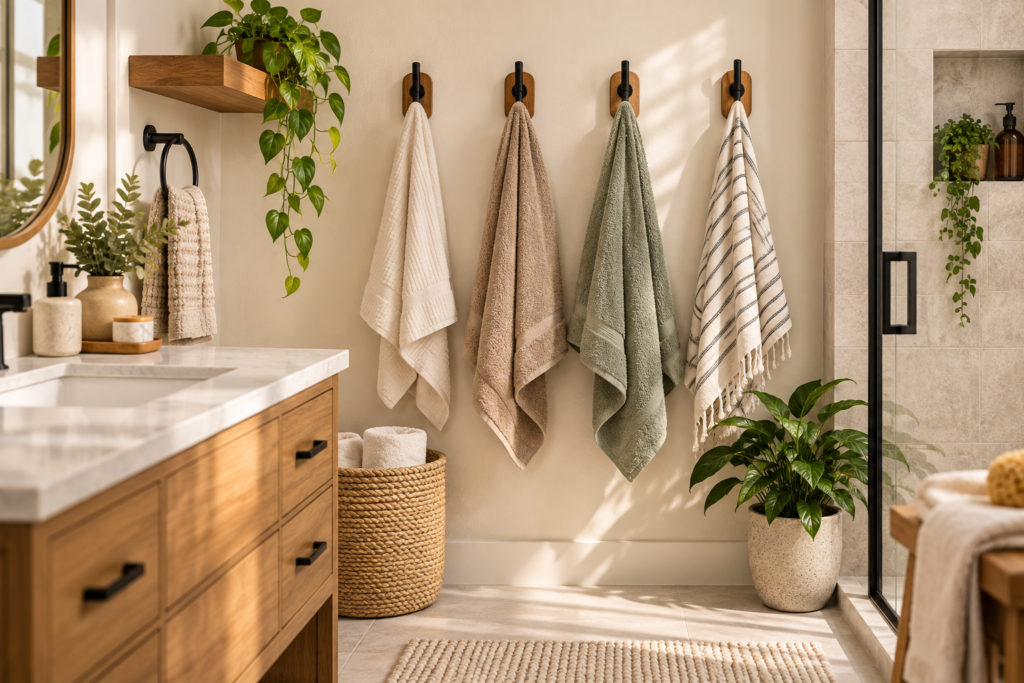
In a shared bathroom, assigning one towel hook to each person is one of the simplest ways to prevent confusion. Arrange the hooks in a neat row and keep the spacing consistent so every towel has its own defined location.
You can identify the hooks with small labels, initials, or simply a consistent left-to-right order. The system works best when everyone knows which hook belongs to them and returns the towel to the same place after use.
2. Install Hooks Beside the Shower
A hook positioned close to the shower keeps a bath towel within easy reach when you need it most. Look for a section of wall that can be reached comfortably without requiring you to stretch awkwardly or walk across a wet floor.
Keep the hook outside areas that receive constant direct spray. The goal is convenient access without leaving the clean towel unnecessarily exposed to water.
3. Use the Back of the Bathroom Door
The back of the bathroom door is valuable vertical space, particularly in a compact room. A few well-spaced hooks can store bath towels or robes without occupying the main walls.
Before installing them, check how the door opens against the wall. Thick towels and bulky hooks need enough clearance so they do not hit nearby fixtures or prevent the door from opening fully.
4. Arrange Hooks Vertically on a Narrow Wall
A narrow wall may not have enough width for a traditional towel bar, but it can often accommodate several hooks arranged vertically. This is useful beside a vanity, near a shower enclosure, or in another slim section of unused wall.
Avoid positioning the hooks directly above one another if damp towels will overlap. A slightly staggered arrangement can provide more separation while still taking advantage of vertical space.
5. Add Hooks to an Open Storage Nook
If your bathroom includes a small storage nook or recessed area, combine hooks with shelves or baskets to create a practical everyday station. Folded clean towels can stay above while the towel currently in use hangs below.
Keeping related items together can make the bathroom easier to use while reducing the number of storage solutions scattered around the room.
6. Pair Hooks with a Floating Shelf
A floating shelf with hooks underneath provides two types of storage within the same section of wall. Use the shelf for lightweight bathroom essentials or neatly folded towels and reserve the hooks for towels that are currently being used.
Keep the shelf reasonably shallow in tight spaces so it does not project too far into a walkway. The hooks should also allow hanging towels to clear anything positioned underneath.
7. Use Double Hooks Carefully
Double hooks can provide extra hanging capacity without requiring additional wall space. They are useful for pairing a bath towel with a lightweight robe or keeping two related items in one location.
However, avoid routinely piling several damp towels onto the same hook. Extra capacity is only helpful when the hanging items still have enough room to remain manageable and dry between uses.
8. Create a Kids’ Towel Hook Zone
Place children’s towel hooks at a height they can comfortably reach without climbing or asking for help. Giving children an accessible storage spot can make it easier for them to return towels after bathing or washing their hands.
Choose a location that does not interfere with adult towel storage. A lower section of wall or a separate row of hooks can create a clear family-friendly system.
9. Use Hooks Near the Vanity for Hand Towels
A compact hook beside the vanity is often enough for a hand towel. It occupies less wall space than a long bar and keeps the towel close to the sink where it is actually needed.
Position it where the towel will not rest against the countertop or sink basin. A dedicated hand-towel hook also helps keep bath towels separate from smaller everyday linens.
10. Add Hooks to a Wall-Mounted Storage Panel
A wall-mounted panel can create a defined towel station while adding visual structure to a plain bathroom wall. Attach a small number of hooks at consistent intervals and use the panel to visually group them together.
This approach can work particularly well when individual hooks would otherwise appear randomly scattered across the wall. Choose moisture-appropriate materials and hardware for the bathroom environment.
11. Keep Guest Towels in a Separate Zone
If you regularly have guests, avoid mixing guest towels with the household’s everyday towels. A separate hook near the sink or guest-use area makes it clear which towel is available for them.
Keep the setup simple. One clearly positioned hand-towel hook is often more useful than adding several decorative hooks that rarely serve a practical purpose.
12. Combine Hooks with a Clean-Towel Basket
Pair a few hooks with a nearby basket or shelf containing clean folded towels. The hooks hold towels currently in use, while the basket provides replacements without mixing clean and damp items together.
This arrangement can work especially well in family bathrooms because it creates an obvious routine: take a fresh towel from the clean storage area, use the assigned hook, and move used towels to the laundry when they are ready to be washed.
Check the Mounting Instructions for Your Product
A weight rating alone does not establish suitability for a bathroom. Check surface compatibility, moisture exposure, preparation, installation and any specified wait before loading. Include the towel when assessing the intended load; do not assume dry fabric and wet fabric weigh the same.
As one manufacturer example, Command’s bathroom installation instructions describe product-specific application and removal steps. Those steps should not be generalized to another adhesive hook or a screw-mounted fitting. Use the instructions supplied with the exact product.
Where drilling is permitted, concealed services and wall construction still matter. Get suitable installation help when they are uncertain. For the rest of a compact room, see small bathroom storage planning.
Common Towel Hook Mistakes to Avoid
One common mistake is placing too many hooks close together. A row may look organized when empty, but large bath towels require significantly more space once they are hanging. Test the arrangement with actual towels before finalizing the layout.
Another mistake is choosing locations based entirely on appearance. A beautifully aligned hook is not useful if it is too far from the shower or hidden behind an open door whenever you need the towel.
Avoid using weak adhesive solutions for heavy wet bath towels unless the product is specifically designed for the surface, environment, and expected load. Bathrooms experience humidity and moisture, so installation method matters.
Finally, do not treat hooks as unlimited storage. If robes, clean towels, used towels, clothing, and miscellaneous items all accumulate on the same hooks, the organization system quickly stops working. Give hooks a specific purpose and move laundry or rarely used items elsewhere.
Frequently Asked Questions
Are hooks good for bathroom towels?
Yes. Hooks can be a practical option when wall space is limited or when each person needs an individual towel location. The layout should provide enough room for towels to hang without becoming heavily bunched together.
How far apart should bathroom towel hooks be?
There is no single spacing that works for every towel and bathroom. Large bath towels need more separation than small hand towels. Temporarily mark the proposed positions and hang your actual towels before installation to determine comfortable spacing.
Where should towel hooks be placed in a small bathroom?
Useful locations include the back of the door, beside the shower, near the vanity, or on a narrow unused wall. Choose locations based on accessibility and clearance rather than filling every available wall.
Can I put towel hooks behind the bathroom door?
Yes, provided there is enough clearance between the door, wall, and nearby fixtures. Test the door with a towel hanging from the hook before making the installation permanent.
How can I organize towels in a shared family bathroom?
Give each person a dedicated hook and keep clean replacement towels in a separate basket, shelf, or cabinet. A consistent arrangement makes it easier for family members to identify and return their own towels.
Should hand towels and bath towels use the same hooks?
They can, but separate locations are usually more convenient. Hand towels work best near the sink, while bath towels should be accessible from the shower or tub. Organizing by use keeps the room more intuitive.
Check the Setup After Use
Review whether towels remain separated, accessible and clear of fixtures. If fabric stays bunched or damp, revise the layout and consider a bar that allows it to spread out. A hook that loosens or a towel that blocks the door requires a change; extra hooks alone will not resolve either problem.