What this guide covers: Compare bedroom locations and storage formats for an entire jewelry collection, including boxes, hanging storage and a daily return spot. For the setup inside one drawer, see our measured jewelry drawer guide.
Jewelry is easy to collect and surprisingly difficult to keep organized. A few necklaces on a dresser can quickly become tangled, earrings disappear into drawers, and rings end up scattered between trays, boxes, and bedside tables. The right bedroom jewelry storage ideas can make your collection easier to see, protect delicate pieces, and reduce everyday clutter without turning your bedroom into a display case.
The best setup depends on what you own and how often you wear it. Someone with a small everyday collection may only need a divided tray, while a larger collection can benefit from drawers, wall storage, and separate compartments for different jewelry types. The goal is not to buy as many organizers as possible. It is to give each piece a practical, consistent place to return to after you wear it.
Table of Contents
- Why Organize Jewelry in the Bedroom?
- 1. Decide Whether Drawer Storage Fits Your Room
- 2. Keep Everyday Jewelry in a Small Catchall Tray
- 3. Hang Necklaces on Individual Hooks
- 4. Use a Traditional Jewelry Box
- 5. Give Occasion Jewelry a Separate Closed Home
- 6. Store Earrings on a Dedicated Organizer
- 7. Use Stackable Trays for a Growing Collection
- 8. Create a Small Jewelry Zone Near Your Mirror
- 9. Keep Valuable Pieces in Concealed Storage
- 10. Separate Jewelry by Type and Frequency of Use
- 11. Use Vertical Storage in a Small Bedroom
- 12. Declutter Before Buying More Organizers
- How to Choose the Right Jewelry Storage
- How to Organize Your Jewelry Step by Step
- How to Store Jewelry More Carefully
- Common Jewelry Storage Mistakes
- Frequently Asked Questions
- Final Thoughts
- Choose a Jewelry Home by Your Dressing Routine
Why Organize Jewelry in the Bedroom?
Jewelry storage is about more than making a dresser look tidy. Necklaces can knot together, earrings can become separated, and delicate pieces can be scratched when everything is dropped into one container. An organized system makes it easier to find what you want while reducing unnecessary handling.
Good storage can also simplify your morning routine. Instead of searching several drawers for a matching pair of earrings, you can see your frequently worn pieces in one place. In a small bedroom, that organization is especially useful because jewelry can otherwise consume valuable dresser and nightstand space.
Before choosing an organizer, take a quick inventory of your collection. Pay attention to whether you own mostly necklaces, rings, earrings, bracelets, watches, or a mixture. Your storage should match the collection rather than forcing every piece into the same type of container.
1. Decide Whether Drawer Storage Fits Your Room
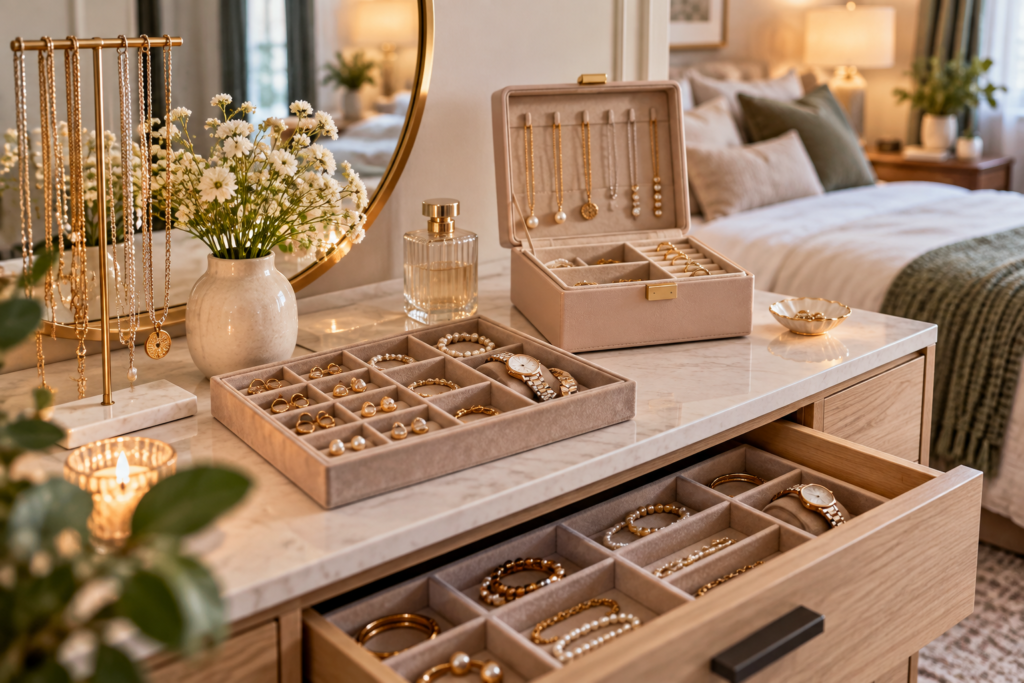
A drawer is useful when clear surfaces and dust protection matter more than displaying the collection. Choose a location near your dressing mirror, then check whether its capacity suits the pieces you wear. If a drawer would displace essential clothing, a compact box or concealed wardrobe organizer may work better.
For insert measurements and compartment layouts, follow our jewelry drawer organization guide.
2. Keep Everyday Jewelry in a Small Catchall Tray
If you regularly wear the same watch, ring, bracelet, or pair of earrings, a small tray can be useful for temporary storage. Place it on your dresser or nightstand so you have one designated spot for pieces removed at the end of the day.
The key is keeping this tray intentionally small. It should hold your current everyday pieces rather than becoming a permanent dumping ground for the entire collection.
Once a week, return anything you are no longer wearing regularly to its proper storage location. This tiny habit prevents the tray from gradually turning into another cluttered surface.
3. Hang Necklaces on Individual Hooks
Necklaces are particularly prone to tangling when they are piled together. Individual hooks allow chains and pendants to hang separately, making them easier to see and access.
Hooks can be installed inside a wardrobe door, on a small wall-mounted jewelry rack, or on the interior of a cabinet. Leave enough distance between hooks for longer necklaces to hang without overlapping heavily.
For a calmer visual appearance, concealed hooks inside a wardrobe or cabinet are often better than covering an entire bedroom wall with jewelry.
4. Use a Traditional Jewelry Box
A well-designed jewelry box remains useful because it combines several storage types in a compact footprint. Look for one with ring rolls, small earring compartments, larger sections for bracelets, and hooks or separate areas for necklaces.
Choose the size based on your actual collection. An oversized box can occupy valuable dresser space, while a box that is too small encourages pieces to be stacked together.
A lid also provides some protection from household dust and helps keep the bedroom visually uncluttered when the jewelry is not being used.
5. Give Occasion Jewelry a Separate Closed Home
Keep wedding, celebration and sentimental pieces apart from everyday accessories. A closed box in a dry bedroom location reduces handling and helps preserve a calm dressing area. Separate pieces according to their individual care instructions; one storage material is not suitable for every gemstone or finish.
Choose the location with both care and security in mind. A concealed drawer provides visual privacy but does not replace appropriate security for valuable items.
6. Store Earrings on a Dedicated Organizer
Earrings often create disproportionate clutter because individual pieces are small and easy to lose. A dedicated earring organizer can keep pairs together and visible.
For stud earrings, divided trays are usually convenient. Hanging earrings can work well on a stand or organizer with small openings. Whichever method you choose, avoid crowding too many pairs into the same space.
Keeping similar styles together—such as studs, hoops, and longer earrings—can also reduce the time spent searching through the collection.
7. Use Stackable Trays for a Growing Collection
Stackable jewelry trays are useful when one drawer or jewelry box no longer provides enough room. Instead of spreading jewelry across several bedroom surfaces, you can expand the system vertically.
For example, one tray can hold earrings and rings, another bracelets and watches, and another less frequently worn pieces. Labeling is usually unnecessary if each layer has a clear purpose.
Keep your most frequently used tray on top so you do not have to move several layers every morning.
8. Create a Small Jewelry Zone Near Your Mirror
Storage is easier to maintain when it fits naturally into your routine. If you usually put on jewelry in front of a bedroom mirror, create a compact jewelry zone nearby.
This might include a drawer organizer beneath the mirror, a small tray for daily pieces, and a few necklace hooks inside an adjacent wardrobe. Keeping related items together reduces unnecessary movement around the room.
A defined zone also prevents jewelry from spreading across your dresser, nightstand, bathroom counter, and other surfaces.
9. Keep Valuable Pieces in Concealed Storage
Not every piece of jewelry needs to be visible. Sentimental, expensive, or rarely worn pieces are generally better kept in a more secure and discreet location than an open tabletop organizer.
Follow any care guidance provided by the jeweler for specific materials or gemstones. For genuinely valuable items, consider security requirements separately from everyday bedroom organization.
The Gemological Institute of America also provides jewelry care guidance, including precautions for different gemstones and cleaning methods.
10. Separate Jewelry by Type and Frequency of Use
A useful jewelry system considers both what an item is and how often you use it. Frequently worn pieces should occupy the easiest-to-reach areas, while special-occasion jewelry can be stored deeper in a drawer or lower in a stack of trays.
Within those groups, separate necklaces from earrings, rings, bracelets, and watches. This makes the collection easier to scan and reduces unnecessary contact between different pieces.
If you consistently return jewelry to the same section, maintaining the system becomes much easier.
11. Use Vertical Storage in a Small Bedroom
When drawer and dresser space is limited, use an overlooked vertical surface. A narrow wall-mounted organizer or hooks inside a wardrobe door can provide storage without occupying the floor or tabletop.
Interior wardrobe storage is particularly useful because it keeps the bedroom looking calm while still making jewelry accessible. Make sure anything mounted to a door is secure and positioned so pieces do not get caught when the door closes.
For more ideas on making better use of bedroom storage zones, see our bedroom hat storage ideas.
12. Declutter Before Buying More Organizers
Buying a larger jewelry box is not always the best solution. Before adding storage, go through the collection and identify broken pieces, unmatched earrings, items you no longer wear, and inexpensive pieces you genuinely do not want.
Repair worthwhile pieces where practical, and choose an appropriate way to donate, recycle, sell, or responsibly dispose of anything you no longer need.
Once the collection reflects what you actually use and value, it becomes much easier to choose storage of the correct size.
How to Choose the Right Jewelry Storage
Start with the collection rather than the organizer. If necklaces dominate your collection, prioritize hanging space. If you mainly own rings and earrings, shallow divided trays may be more useful. Watches and larger bracelets need wider compartments.
Also consider the available bedroom space. Drawer storage is ideal when you want clear surfaces, while vertical organizers can help when drawers are limited. A compact jewelry box may be sufficient for a smaller collection.
Accessibility matters too. An organizer that requires several steps to open or rearrange every day may look attractive but can be difficult to maintain. The easiest storage system is usually the one you are most likely to use consistently.
How to Organize Your Jewelry Step by Step
- Gather your jewelry. Bring pieces from dressers, nightstands, drawers, bags, and other storage locations into one sorting area.
- Separate by type. Create groups for necklaces, rings, earrings, bracelets, watches, and other accessories.
- Remove obvious clutter. Set aside broken, unwanted, or unmatched pieces that need a decision.
- Identify everyday jewelry. Give frequently worn items the easiest-to-reach storage.
- Measure the available space. Check drawer dimensions, dresser space, or wall areas before purchasing organizers.
- Assign a permanent home. Give every category a defined compartment, hook, tray, or box.
- Review the system after a few weeks. If jewelry repeatedly ends up outside the organizer, adjust the setup to better match your habits.
How to Store Jewelry More Carefully
Organization and jewelry care overlap. Avoid throwing multiple delicate pieces into one open container, especially fine chains that can knot or items that may scratch one another.
Keep jewelry away from situations that expose it unnecessarily to moisture, chemicals, cosmetics, or household products. Care requirements can vary significantly depending on the metal, gemstone, coating, and construction, so follow professional or manufacturer guidance for valuable pieces.
For jewelry you rarely wear, clean and store it appropriately before putting it away rather than leaving residue on the piece for extended periods.
Common Jewelry Storage Mistakes
Keeping Every Necklace in One Pile
This almost guarantees extra time spent untangling chains. Give delicate necklaces individual hooks or separated spaces.
Using an Organizer That Is Too Small
If every compartment is overflowing, the system becomes difficult to maintain. Either declutter the collection or choose storage that realistically accommodates it.
Leaving Valuable Jewelry in Plain Sight
Open displays may be convenient for inexpensive everyday accessories, but more valuable or sentimental pieces deserve a more considered storage location.
Buying Storage Before Sorting
Without knowing what you actually own, it is easy to purchase an organizer with the wrong combination of hooks, compartments, and drawer space.
Ignoring Your Daily Routine
A beautiful organizer placed far from where you get dressed may go unused. Put everyday storage where returning jewelry feels natural.
Frequently Asked Questions
What is the best way to organize jewelry in a bedroom?
For many bedrooms, a combination works best: divided drawer trays for small pieces, individual hooks for necklaces, and a small catchall tray for jewelry currently worn every day.
How can I organize jewelry without taking up dresser space?
Use a shallow dresser drawer, hooks inside a wardrobe door, or a narrow wall-mounted organizer. These options use existing or vertical space instead of covering the dresser top.
How do I keep necklaces from getting tangled?
Store necklaces separately rather than piling several chains together. Individual hooks or long divided compartments can help keep chains apart.
Where should I put jewelry that I wear every day?
Keep a small designated tray or easy-access compartment near the place where you normally get dressed. Return pieces there consistently instead of leaving them on random surfaces.
Should jewelry be stored in the bedroom or bathroom?
A bedroom is often a practical location because jewelry can be kept away from routine bathroom moisture and products while remaining close to clothing and dressing areas. Specific pieces may have their own care requirements.
How do I organize a large jewelry collection?
Divide the collection first by jewelry type and then by frequency of use. Stackable trays, a dedicated shallow drawer, and separate necklace storage can provide more capacity without creating a cluttered dresser.
Choose a Jewelry Home by Your Dressing Routine
Before shopping, note where you put jewelry on and take it off for three ordinary days. If pieces accumulate beside the bed, place a small temporary return tray there and empty it into permanent storage regularly. If you choose accessories at a wardrobe mirror, locate the main collection nearby rather than scattering it across several surfaces.
- Mostly long necklaces: consider individual concealed hanging points, with room for pendants to hang freely.
- Small mixed collection: a closed box may replace several separate organizers.
- Growing collection with free drawer space: use modular drawer storage and keep everyday pieces easy to reach.
- Limited surfaces and drawers: compare the inside of a wardrobe door with a narrow wall organizer before adding furniture.
Test access with the mirror, wardrobe door and nearby furniture in normal use. If returning an item requires moving several objects, change the location before expanding the system. Keep valuable-piece security and material-specific care separate from this convenience test.
Final Thoughts
The most effective bedroom jewelry storage ideas do not require a complicated organizing system. They simply make your collection visible, accessible, and easy to return to the correct place.
Start by sorting what you already own, remove pieces you no longer need, and then choose storage based on the collection that remains. A divided drawer tray, a few necklace hooks, or a compact jewelry box may be all you need. When each ring, necklace, bracelet, and pair of earrings has a defined home, your bedroom stays tidier and getting ready becomes easier.